Three Days Scouting the Gold Coast's Hidden Photography Gold
From Bortle 2 dark skies at Mount Barney to rainforest waterfalls in Lamington to the Pacific coastline—this is what I found, where the light actually works, and why no one else runs workshops like this.
Mount Barney: The Moment Everything Clicked
I won't bury the lead: Mount Barney stopped me cold.
I've spent years chasing dark skies. I lived in Utah surrounded by 14,000ft peaks. I've shot the Milky Way across the American Southwest, New Zealand's South Island, and Australia's Red Centre. But hiking up to Yellow Pinch Lookout at Mount Barney—watching glimpses of surrounding peaks appear through the trees, the anticipation building with every switchback—I wasn't prepared for what hit me when I crested that final rise.
The scale. The drama. The sheer presence of it.
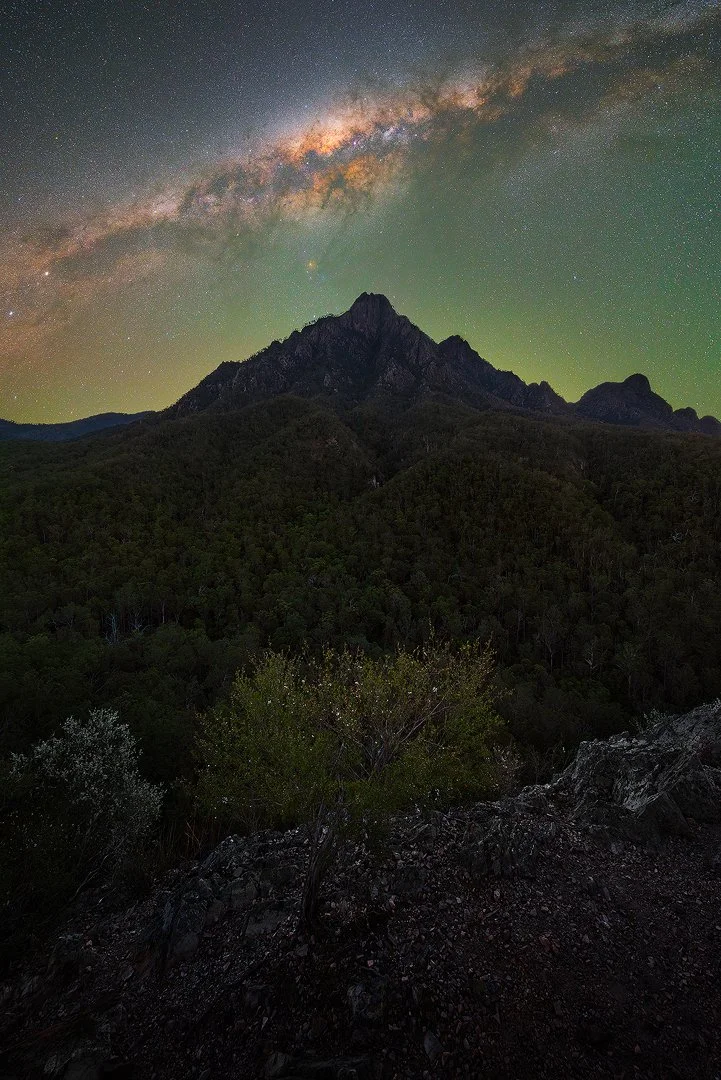
Tracked Milky Way over Mount Barney—one of the darkest accessible locations in Southeast Queensland
Bortle 2 Dark Skies—Confirmed
Yellow Pinch Lookout sits in a Bortle 2 dark sky zone. Not Bortle 3. Not "dark enough." Bortle 2—SQM reading of 21.95 mag/arcsec², artificial brightness just 8.07 μcd/m². This is one of the darkest accessible locations in Southeast Queensland, and you can drive to it.
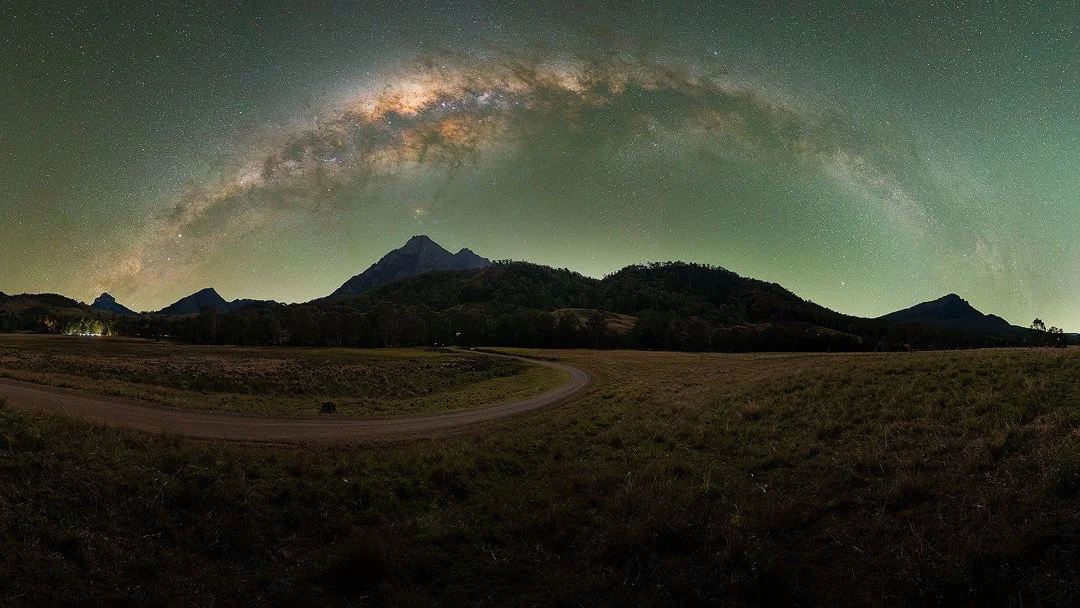
That first night: clear skies, soft twilight painting the ridgelines, and the Milky Way core arcing overhead. I shot tracked frames over Mount Barney's eastern face, then stitched a wide panorama as the galactic core stretched from horizon to horizon. The kind of night you chase for years, and it delivered on the very first scout.
I knew in that moment this workshop was going to be something no one else offers: mountains to sea, dark skies to rainforest to coast, all in five days.
The Next Morning: Roadside Sunrise
Pre-dawn, I drove back down the access road and pulled over at a roadside clearing. No fancy vantage point. Just the right timing and the right awareness of how light moves through these valleys.
The softest, most buttery light woke up the mountain—alpenglow kissing the peaks, pastel blues dissolving into gold. I shot handheld, adjusting composition as the light shifted. Three minutes of perfect conditions, then it was gone.
This is what scouting teaches you: the best shots aren't always from the lookout platforms. Sometimes they're from the side of the road at 6:14am when the light does something unrepeatable.
Why May + August? (The Milky Way Alignment Math)
The workshop timing isn't arbitrary. It's calculated around two variables: Milky Way alignment and temperature tolerance.
Milky Way Positioning
In May, the galactic core rises in the east (perfect for Currumbin Rock, where it emerges directly from the Pacific Ocean) and sets in the west over Mount Barney. This gives us two completely different astro compositions from the same locations.
In August, the core is higher earlier in the evening, still shootable over Mount Barney, and sets 180° opposite over Currumbin Rock's western horizon. Same locations, different season, entirely new compositions.
Temperature + Comfort
May and August bring 18–22°C days and 12–15°C nights. Compare that to summer in Southeast Queensland: 30°C+ with crushing humidity. Hiking mountains with a camera pack, tripod, and overnight gear in January? Miserable. Shooting waterfalls at midday in 85% humidity? Even worse.
Winter clarity also delivers sharper landscape detail, cleaner astro conditions, and fewer crowds at Currumbin Rock (which can get packed during peak tourist season).
Lamington: The Mistake I Made (So You Don't Have To)
I needed clear skies for the astro component of this scout, which meant I hit the Lamington waterfalls mid-day. Big mistake.
Elabana Falls with direct overhead sunlight doesn't work. Harsh shadows on wet rock. Blown highlights where the sun hits the cascade. Patchy, dappled light through the canopy that ruins your composition.
Here's what I learned after testing multiple times of day:
Best light windows:
- Early morning (7–9am, before direct sun hits the falls)
- Late afternoon (after 3pm, when sun drops behind the tree line)
- Overcast days (soft, diffused light filters through the canopy—ideal)
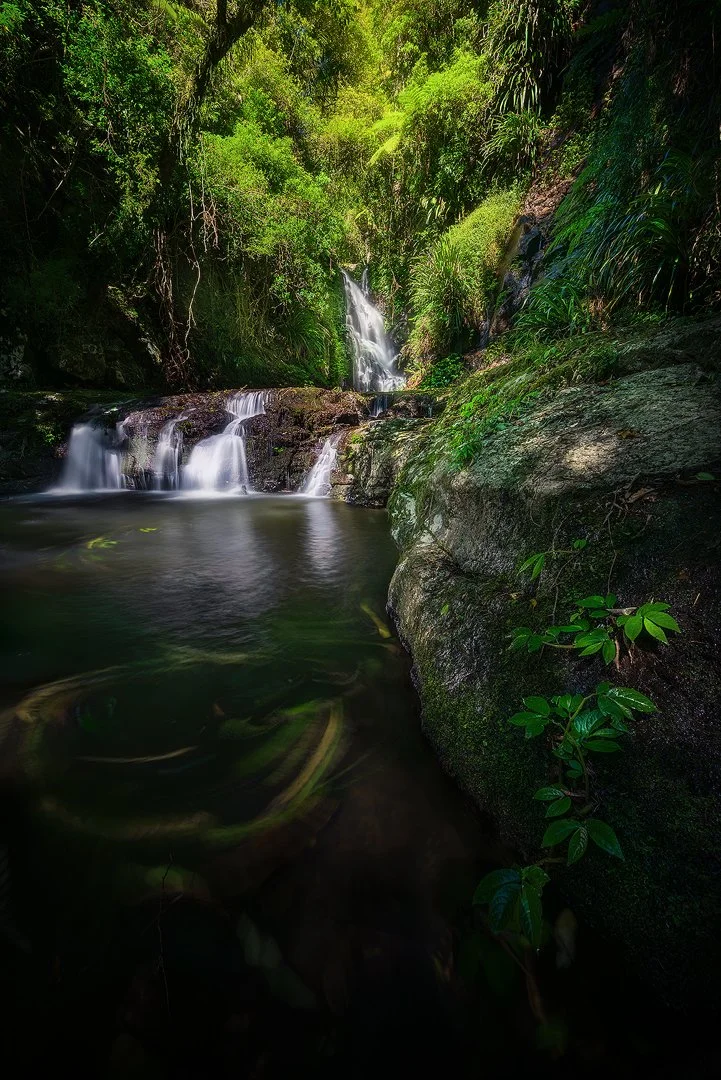
Elabana Falls in soft morning light—the right way to shoot rainforest waterfalls
This is why the workshop is 5 days / 4 nights. We spend 3 days in the mountains, giving us multiple opportunities for astro, rest, waterfall shoots in the right light, and editing sessions. Long rainforest hikes mean you need buffer time.
Composition + Technique: What Actually Works
- Flow rate: Elabana Falls maintains consistent flow year-round—30m cascade with foreground pools and fern framing opportunities
- Polariser technique: Rotate the filter while watching through your viewfinder. You'll see the moment glare cuts from wet rocks and greens deepen without going nuclear. Stop there.
- Shutter speeds: 0.5–2 seconds gives you silky flow without losing texture. Go longer (5–10sec) and you turn water into white mush.
- White balance: 5200K keeps greens natural. Auto white balance in rainforest conditions will often push too warm (yellows) or too cool (cyan cast). Lock it at 5200K.
Currumbin Rock: 360° Seascape + Astro Combo
Currumbin Rock delivers something rare: a 360° opportunity for sunrise, sunset, and astro—all from the same location.
The rock shelf creates natural leading lines. Tidal channels funnel water through gaps—perfect for long-exposure seascapes where the ocean smooths into mist. And the Milky Way rises directly out of the Pacific Ocean to the east.
In May, the galactic core emerges from the ocean at dusk, arcing over Currumbin Rock as the perfect foreground subject. In August, the core sets 180° opposite over the western horizon, giving us a completely different composition from the same spot.
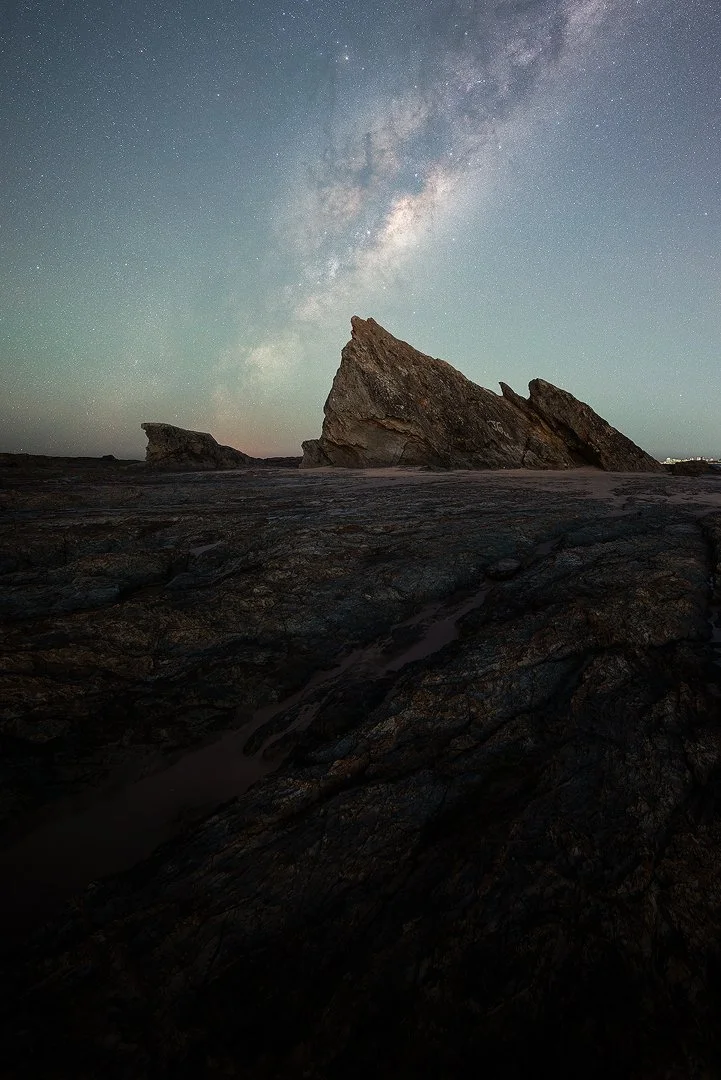
May orientation—Milky Way rising directly from the Pacific Ocean
The Tide-Timing Strategy
Low tide ±1 hour exposes the full rock shelf. Tidal pools reflect sky. Textures emerge. High tide smooths the ocean with long exposures, but you lose foreground detail.
I use Willyweather tide charts and aim for 0.5m or lower. Check it 24 hours before the shoot, then adjust timing on the day based on swell conditions.
There's light pollution here from the Gold Coast—you'll see it on the horizon in astro shots. But the Milky Way is still capturable, and the ocean + seascape combo makes it worth it.
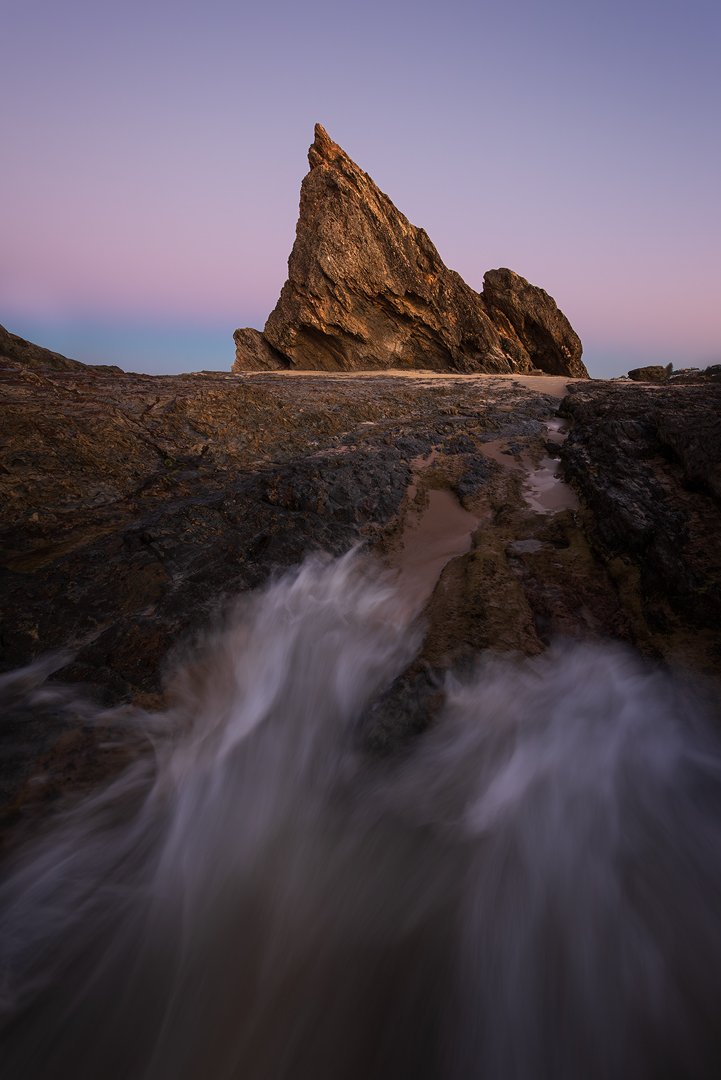
30-second exposure through the tidal channel at sunset
Currumbin Rock also gets busy during peak season, which is another reason we run workshops in May and August—fewer crowds, better conditions, more space to set up without tourists walking through your 30-second exposure.
Fingal Head: Australia's Giant's Causeway
Giant's Causeway in Northern Ireland is perhaps the world's most famous example of basalt columns—formed 50–60 million years ago from volcanic activity. You don't need to fly to Ireland.
Just outside the Queensland border sits Fingal Head, where 17-million-year-old basalt from the Tweed Volcano has eroded into hexagonal columns across a dramatic coastal causeway.
When the Light Works
Low tide exposes the full length of the causeway. Sunrise lights the columns from the south (behind you), creating warm sidelight on the basalt with the blue Pacific as backdrop. Water rushes through channels and over the columns—perfect for long-exposure seascapes.
In May, we also get the Milky Way rising out of the ocean behind the causeway just before dawn. Astro + sunrise in one shoot.
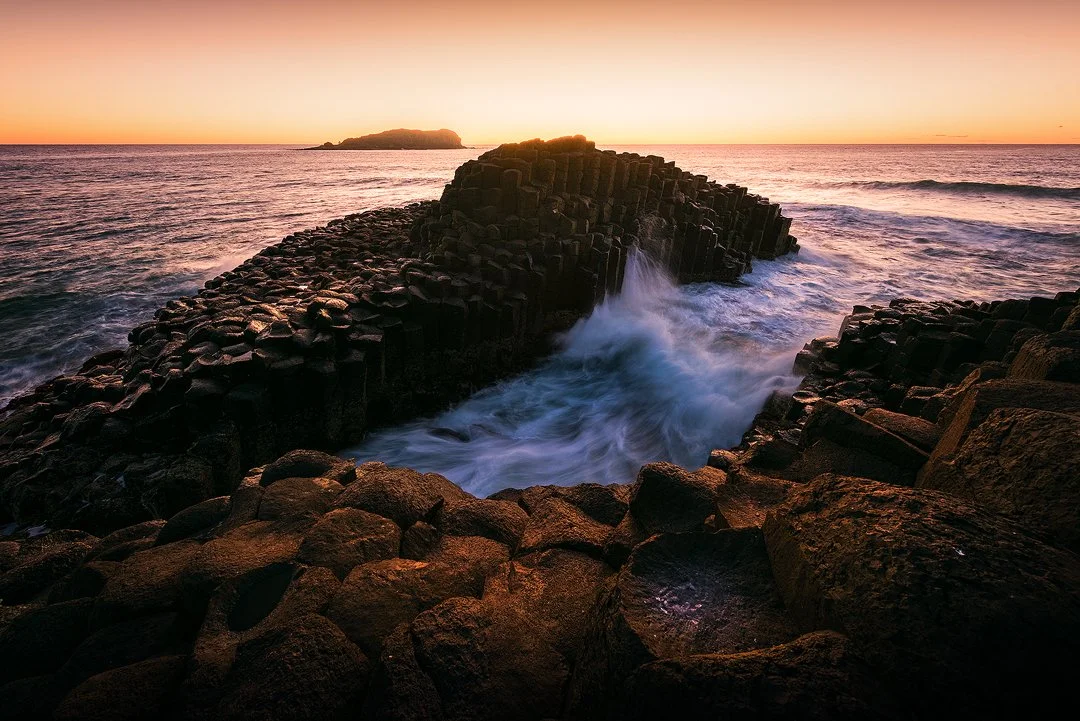
Sunrise lights the basalt columns from the south with the Pacific as backdrop
Arrive 45 minutes early. Scout composition. Set up before the light peaks. You get about 30 minutes of golden hour, then it's gone.
Workshop Itinerary (5 Days / 4 Nights)
Day 1: Mount Barney (Arrival + Sunset + Night)
- BNE pickup (12pm) → Mount Barney (2pm check-in, remote lodge)
- Sunset shoot: Yellow Pinch Lookout (twilight + alpenglow)
- Night shoot: Milky Way over Mount Barney (conditions permitting, 9–10pm)
Day 2: Mount Barney Sunrise → Lamington Transfer
- Sunrise/blue hour: Mount Barney roadside (5:30am, soft morning light)
- Editing lab: Process night files, focus stacking, star tracker workflow
- Drive to Lamington (self-booked accommodation in Green Mountains)
Day 3: Lamington Waterfalls (Full Hike Day)
- Morning: Elabana Falls (Box Forest Circuit) in soft light
- Midday: Moran's Falls Track
- Afternoon: Toolona Creek Circuit (smaller cascades, intimate rainforest)
- Editing lab: Polariser workflow, taming greens, long-exposure waterfalls
Day 4: Editing + Coast Transfer
- Morning editing session (process waterfall files)
- Drive to Kirra (self-booked accommodation, 10% off for workshop participants)
- Sunset: Currumbin Rock seascape
- Night shoot: Milky Way rising over Currumbin Rock (conditions permitting)
Day 5: Fingal Sunrise → BNE Departure
- Pre-dawn: Fingal Head Causeway (Milky Way if May timing aligns)
- Sunrise: Basalt columns + seascape
- Final editing lab: Rydges balcony suite—select + process hero shots
- BNE drop-off (by 1pm for onward flights)
Interested in the full workshop details? See dates, pricing, and what's included →
What You'll Actually Learn
Night Technique (Bortle 2 Conditions)
Repeatable focus routine using live view magnification (not the infinity symbol—it lies). Exposure intent: balancing foreground (natural twilight or light-painted) with sky (tracked or stacked). Star tracker use: loaner available, stacking basics for noise reduction in dark skies.
Waterfalls (Light + Timing)
Why mid-day doesn't work: direct sun creates harsh shadows and blown highlights. Best light windows: early morning, late afternoon, overcast days. Polariser technique: rotate to cut glare, watch through viewfinder in real-time. Shutter speed choices: 0.5sec vs 2sec vs 10sec—when each works.
Seascapes (Tide + Wave Timing)
Wave timing: count sets, shoot on the "pull" when water recedes (smoother motion). Long exposures: 10–30sec for silky ocean, ND filters essential. Tide-aware positioning: know when rocks and channels are exposed vs submerged.
Editing Labs (Daily)
Lightroom: Culling workflow, masking (sky, foreground, selective adjustments). Photoshop: Focus stacking for waterfalls in wind, blend modes for astro composites (disclosed). Colour control: Keep greens natural, skies believable—no nuclear saturation. Final session at Rydges balcony suite with TV hookup for full-room editing setup.
1 Spot Remaining — May 2026
Mountains to sea. Bortle 2 dark skies to rainforest waterfalls to Pacific coastline. Five days. Max 3 photographers. No one else runs workshops like this.
Want the full shot list? Download the complete Gold Coast Photography Location Guide—GPS waypoints, tide charts, PhotoPills screenshots, and exact camera settings for every shot.
Download PDF Shot List (Free)