DWARF Draco vs DWARF Mini: A Real Eastern Veil Nebula Comparison
DWARF Draco vs DWARF Mini:
Real Eastern Veil Nebula Comparison
I processed 80 minutes of real DWARF Draco test data and compared it with 4 hours 27 minutes from my own DWARF Mini on the Eastern Veil Nebula. The datasets are not a controlled speed test, but the difference in fine structure is hard to miss.

When the DWARF Draco launched, I wrote a separate technical analysis based on the published specifications. The hardware looked like a major step beyond the DWARF Mini, particularly for deep-sky resolution, guiding, cooling and longer exposures.
That article was deliberately cautious because specifications are not photographs.
Now I have processed actual Draco deep-sky files.
The target is the Eastern Veil Nebula, one of the better objects for exposing differences in real resolving power because its appearance depends on thin, overlapping H-alpha and OIII filaments rather than broad smooth nebulosity.
I also captured the same target with my own DWARF Mini, giving me a useful real-world comparison.
This is not a laboratory-controlled comparison. The Mini and Draco data were captured on different nights, the individual sub-exposure lengths differ, and the final edits were matched in intent rather than made mathematically identical. The Draco files were supplied by DWARFLAB from a test unit; I independently stacked and processed them.
The short answer
The Mini produced a respectable Eastern Veil image from 4 hours 27 minutes of accepted integration.
The Draco produced a visibly finer result from only 80 minutes.
The important difference is not simply that the Draco image looks cleaner. The Draco data separates filamentary structures that remain broader and more blended in the Mini image.
The Mini captures the Veil. The Draco begins to resolve the Veil.
That is the distinction that matters most to me.
The two datasets
DWARF Mini
- Accepted frames 89
- Exposure 180 s
- Gain 60
- Filter Duo-Band
- Total integration 267 min · 4 h 27 min
DWARF Draco
- Accepted frames 16
- Exposure 300 s
- Gain 60
- Filter H/O dual-narrowband
- Total integration 80 min · 1 h 20 min
The Mini dataset contains more than three times as much total exposure time, but I would not turn that into a claim that the Draco is “3.3× faster”.
Conditions, optics, sampling, filters and exposure lengths differ.
The valid observation is narrower: in these two real datasets, the shorter Draco stack resolves materially finer structure.
The finished images
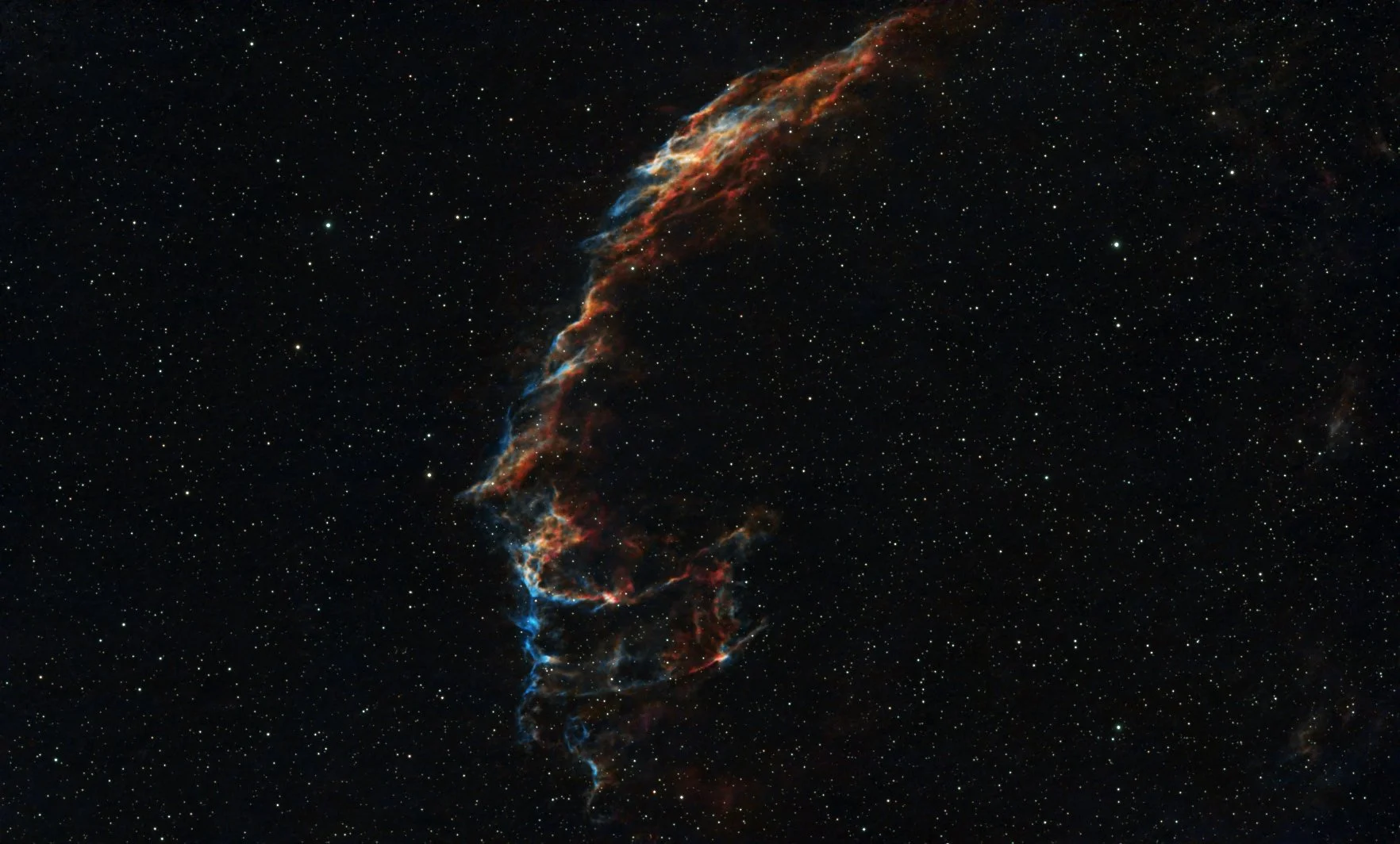
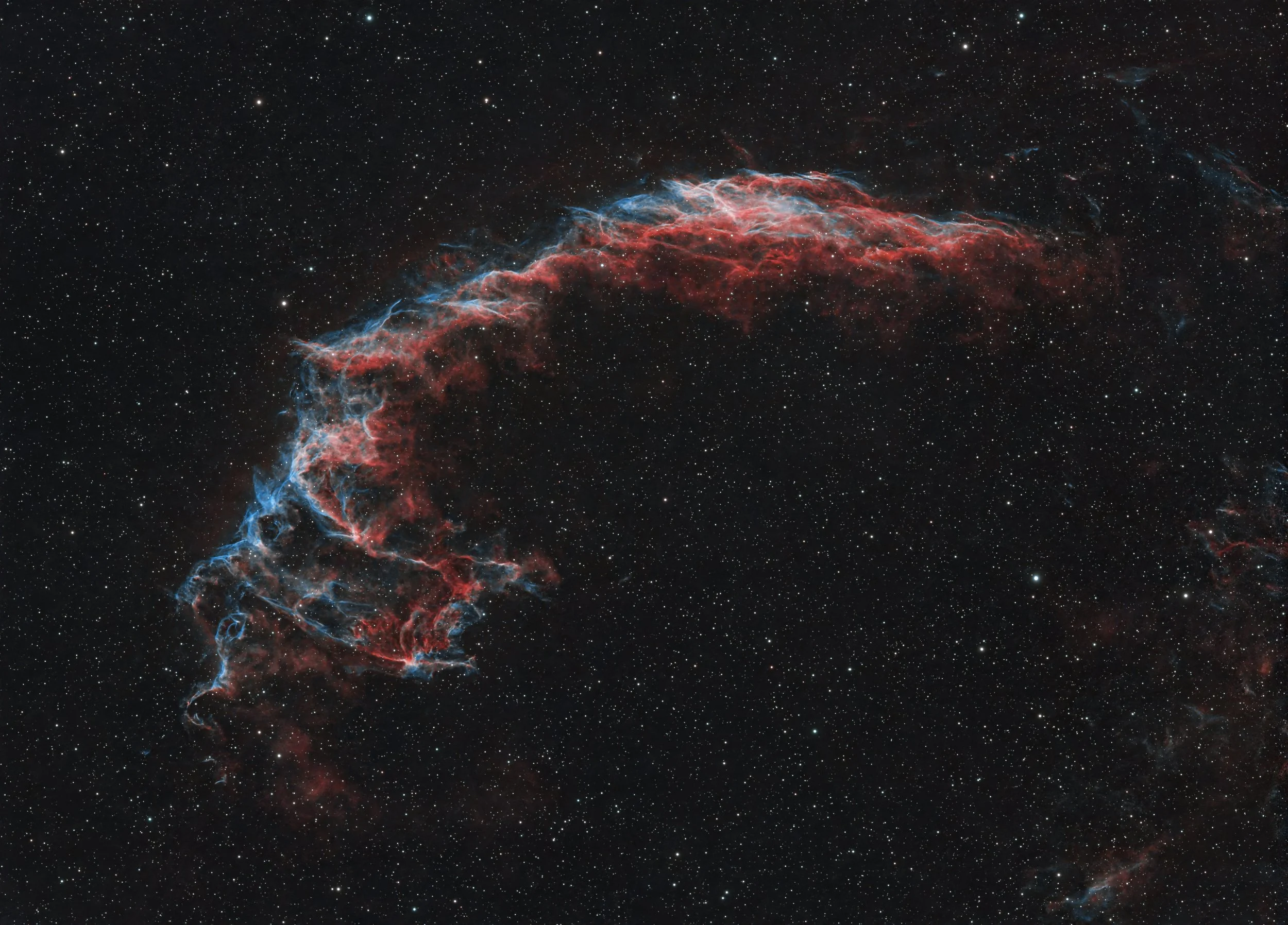
Look at the filaments rather than the overall colour or brightness.
In the Mini image, the broad shape is captured well and the red/blue separation is obvious, but closely packed shock fronts tend to merge into thicker ribbons.
In the Draco image, many of those broad structures break into finer strands.
The strongest difference appears where several filaments overlap: the Draco separates individual threads that the Mini blends together.
70% less integration — what that means
The Draco dataset contains about 30% of the Mini's total integration time.
That does not establish a universal exposure-time multiplier.
It does establish that simply adding more Mini integration did not compensate for the difference in fine spatial structure on this target.
More Mini data would continue to improve noise, faint signal and colour depth.
It would not necessarily create narrow filaments that were already blended together at capture scale.
Where the detail difference appears
The Eastern Veil is a useful stress test because its visual character is built from extremely thin shock fronts and overlapping sheets of ionised gas.
On a broad emission nebula, two systems can look surprisingly similar once both images are stretched and sharpened.
The Veil is less forgiving.
If the capture does not separate adjacent filaments cleanly, processing cannot fully manufacture that missing separation later.
That is exactly what I see here.
- Mini: strong global structure, clear H/O colour separation, broader merged ribbons.
- Draco: thinner individual threads, more separation within overlapping structures, greater crop latitude.
The Draco difference is therefore not just “less noise”.
It is a change in the scale of structure being recorded.
The sampling gap explains part of it
My earlier Draco specifications article calculated the deep-sky image scale from the published optical geometry.
Sampling is not the same thing as true resolved astronomical detail.
Seeing, focus, tracking, optical correction and processing still determine how much of that theoretical grid is useful.
But the direction is exactly what the images suggest: the Draco has substantially more room to separate smaller structures before they collapse into the same pixels.
For the full specification analysis behind those figures, see my DWARF Draco verified specifications and deep-sky analysis .
Image scale and crop latitude

The Mini still has advantages when a very wide field is the goal, but the Draco gives far more pixel density to work with on detail-rich targets.
That matters twice: first when recording fine structure, and again when cropping for presentation.
Why this is not a speed test
The headline numbers are striking, but the limitations matter.
- The data was captured on different nights.
- The sky conditions were not matched.
- The Mini used 180-second sub-exposures; Draco used 300-second sub-exposures.
- The filter systems are not perfectly identical.
- The final edits were similar in intent, but not mathematically identical.
- I captured the Mini data myself; the Draco raw files came from a DWARFLAB test unit.
So I am not claiming that 80 minutes of Draco will always beat 4.5 hours of Mini.
The defensible conclusion is narrower:
In these two real Eastern Veil datasets, the 80-minute Draco stack resolves substantially finer filamentary structure than the 4-hour-27-minute Mini stack.
What it means for a DWARF Mini owner
This comparison does not make the Mini obsolete.
I own two Minis because they are tiny, fast to deploy and capable of producing very good deep-sky images with almost no setup friction.
But the Veil shows where that compact system begins to hit a spatial-resolution ceiling.
If portability, price and a very simple workflow are the priority, the Mini still makes sense.
If the priority has shifted toward fine deep-sky detail, crop latitude, smaller structures and a more serious imaging ceiling , Draco is making a much stronger case.
For me, the Eastern Veil is now firmly a Draco target.
The Mini version is useful as a benchmark. The Draco version is the one I would continue developing.
What I will test with my own Draco
This first comparison uses genuine Draco data, but it is still test-unit data supplied by DWARFLAB.
I pre-ordered my own Draco at launch and expect to be among the earlier Australian deliveries, subject to DWARFLAB's shipping schedule.
Once my production unit arrives, I can run much tighter comparisons:
- same target, same night and same location where practical;
- matched total integration time;
- matched processing intent;
- frame acceptance and guiding consistency;
- star FWHM and eccentricity;
- cooling behaviour through Queensland conditions;
- 30, 60, 120 and 300-second equal-total-integration tests;
- broadband galaxy structure and HII-region resolution;
- narrowband filament detail;
- sensor rotation and repeatable composition;
- multi-night reliability and calibration; and
- how far the Draco FITS files can be pushed in PixInsight.
I also plan to repeat the Mini-vs-Draco comparison across different target classes.
The Veil is ideal for filament resolution; galaxies should tell us much more about HII regions, dust lanes and smaller-scale structure.
Want the production Draco comparisons?
I will publish the matched tests, first-light images and processing results as soon as my own unit arrives.
Join the photography newsletterFor the deeper hardware analysis behind the 90 mm aperture, 340 mm focal length, guiding, cooling, deep-sky sampling and 300-second exposure capability, read DWARF Draco: Verified Specs, What Actually Matters and Who It Is For .
DWARFLAB supplied my first DWARF Mini on a six-month loan. I later bought a second Mini myself at full price and subsequently joined the DWARFLAB affiliate program. I also purchased my own DWARF Draco during the launch pre-order.
The Draco raw data used in this article was supplied by DWARFLAB from a test unit. I independently stacked and processed the files. DWARFLAB did not control my conclusions or final comparison.
Code DYLAN gives customers a discount on qualifying DWARFLAB products, and I may receive a 5% commission from qualifying purchases.
- DWARFLAB — Draco Smart Telescope product specifications.
- DWARFLAB — DWARF Mini Smart Telescope specifications.
- NASA / Hubble — Caldwell 33 / Eastern Veil Nebula background information.
- Dylan Knight — DWARF Draco: Verified Specs, What Actually Matters and Who It Is For .
- Original Mini and Draco FITS datasets processed independently for this comparison.