Why I Returned to Deep-Sky Astrophotography in 2026
Why I Returned to
Deep-Sky Astrophotography in 2026
I began photographing the night sky in 2017, but a dedicated deep-sky setup never quite stuck. Nine years later, a tiny smart telescope has pulled me properly into the telescope side of astrophotography.
I bought my first serious camera near the end of 2016. By 2017, astrophotography had become my favourite genre, and it still is.
I cannot completely explain why. There is something amazing about pointing a camera into the night and recording objects in space. We can photograph planets, clouds of gas where stars are being born, and the remains of stars that exploded thousands of years ago. Much of it is invisible to our eyes from the ground, but a camera can slowly collect enough light to reveal it.
The creative side is just as addictive. Astrophotography starts with data rather than a finished scene. That data may be collected over hours, across multiple nights and through different wavelengths of light. The way it is combined, processed and presented gives you enormous artistic freedom. It can be highly technical and completely creative at the same time.
That combination had me hooked early.
Nine years of wide-field astrophotography
For most of the next nine years, my astrophotography centred on wide-field landscapes and the Milky Way. I built a landscape photography business, spent countless nights under dark skies and taught other photographers how to plan, capture and process difficult night scenes.
I also dabbled in deep-sky imaging with a Nikon D810 and a 400 mm lens. In deep-sky terms, 400 mm on a full-frame camera is still a wide-field setup. It covers roughly 5.1° by 3.4° of sky, although it felt extremely tight after years of working with wide-angle landscape lenses.
That setup let me isolate larger nebulae and star fields, but it was not the same as running a dedicated telescope, tracking mount, astronomy camera and control system. I looked at taking that next step several times, but it never properly happened.
Why a dedicated deep-sky rig never happened
The cost was the first barrier. A capable traditional setup requires much more than a telescope. You need a suitable mount, camera, power, guiding, control hardware and all the smaller parts that make the system work together. A good rig was expensive then, and a good rig is still expensive now.
Complexity was the second barrier. Buying everything is only the start. You need to assemble a reliable system, align it, connect it, control it, troubleshoot it and learn how to capture usable data. Then you still need to learn calibration, stacking and processing.
Sometimes the available technology or equipment stopped me. Other times life simply did not leave enough room to take on another expensive and demanding system.
The interest never went away. The practical path into it just never felt right.
The Mini arrived at exactly the right time
I had recently started looking seriously at deep-sky imaging again when DWARFLAB contacted me about testing the DWARF Mini, one of its newer smart telescopes.
I thought it looked interesting, so I said yes.
The Mini is small enough to hold in one hand and quick enough to set up in the backyard after work. It can locate and track a target, capture a sequence of exposures and build a live stack while the session runs.
Most importantly for me, it also saves the raw FITS files. I can use the automated capture system to collect data, then take those files into PixInsight and process them properly. I am not limited to whatever result appears in the app.
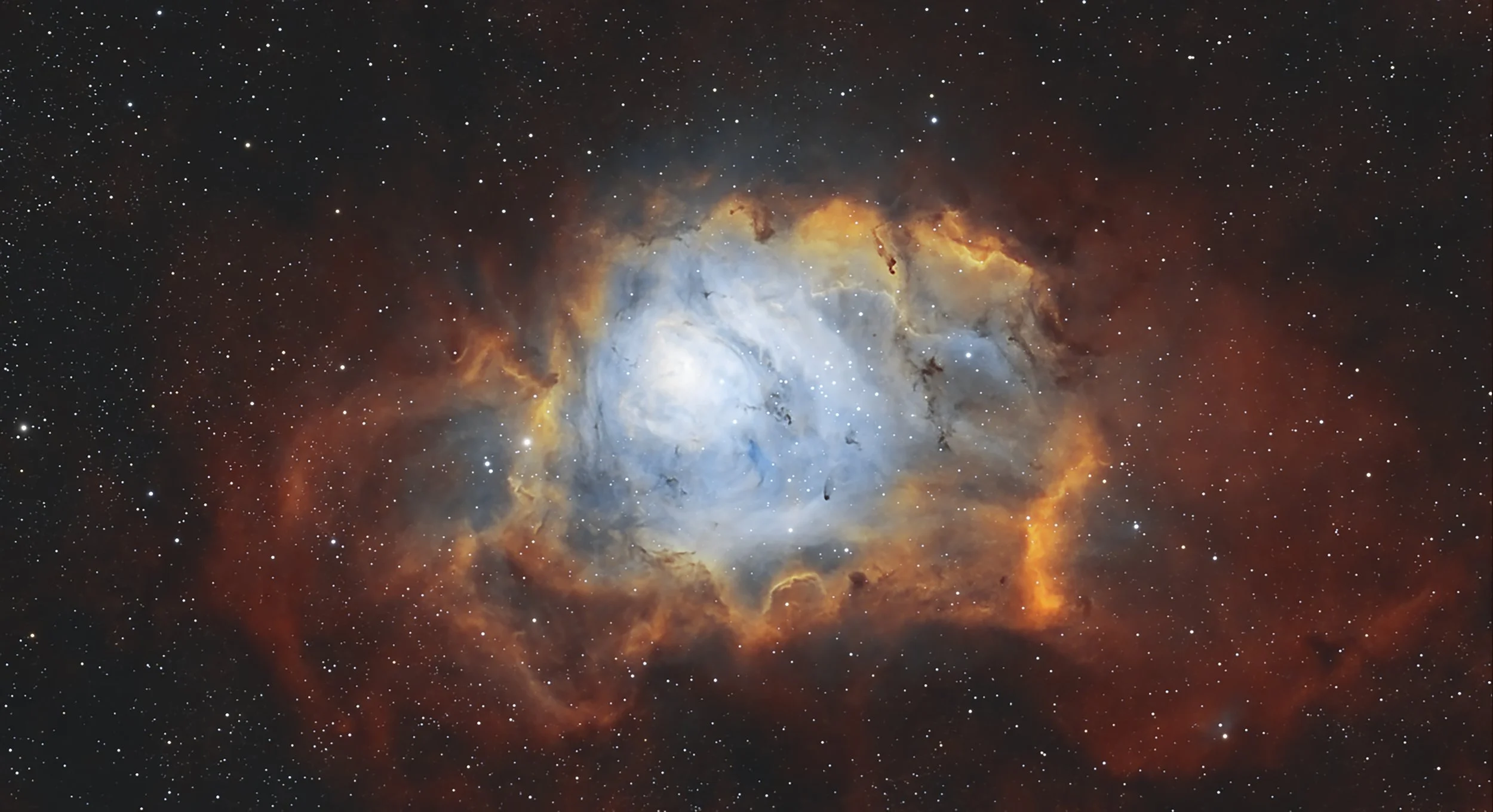
My first proper target was the Lagoon Nebula from my backyard on the Sunshine Coast. A few hours later, M8 was sitting on my screen with bright hydrogen emission, dark dust lanes and far more structure than I expected from such a small telescope.
The image was not perfect. The data was still shallow, and the processing took several attempts. That did not matter. I had captured a deep-sky object from home with a telescope I could set up in minutes.
The bug was back immediately.
What smart telescopes actually changed
The price of a serious traditional rig has not magically disappeared. Smart telescopes have changed the amount of knowledge and equipment needed before someone can collect their first usable data.
They combine the optics, camera, mount, tracking and control system into one compact unit. Plate solving handles target location. The app manages capture and live stacking. The feedback is immediate enough to tell whether the target is framed correctly and whether the session has a chance of working.
I could not have timed my return much better. Smart telescopes are in a genuine arms race. Manufacturers are competing on optics, sensors, filters, tracking, automation and software. New models are arriving quickly, while existing products keep improving through firmware and app updates.
The ability to work from home is just as important.
Wide-field Milky Way photography still depends heavily on location. A normal camera and lens record the broad glow from streetlights and nearby development along with the stars and dust we want. Dark skies are difficult to replace when the goal is a natural broadband image.
Emission nebulae give us another option. The Mini's duo-band filter passes narrow regions around hydrogen-alpha and oxygen III while blocking much of the broadband glow from artificial light and moonlight. It does not make a bright Moon or suburban light pollution disappear, especially when the Moon is close to the target. It does make productive backyard imaging possible on nights I would never use for conventional Milky Way photography.
That is a major change for me. I can set the telescope running at home, collect several hours of data and process it later. Dark sites still matter enormously for galaxies, reflection nebulae and natural broadband colour, but they are no longer the only place where worthwhile astrophotography can happen.
The first two weeks were a reality check
Smart telescopes make acquisition easier. They do not remove the need to understand what you are doing.
The telescope can locate a nebula, but it cannot decide which target deserves tonight's limited clear window. It does not know which object is disappearing for the season, whether the Moon will ruin broadband data, or whether another hour on one target is more valuable than starting another.
It can capture hundreds of exposures, but it cannot turn cloud, poor focus, bad tracking or weak signal into good data. A live stack can look encouraging on a phone while the individual files tell a very different story.
I learnt that quickly.
The Lagoon showed me how much structure the Mini could collect from a suburban backyard. The Swan Nebula showed what the duo-band filter could recover under significant moonlight. A six-hour Helix session produced less than 40 minutes of usable data after cloud rejection. The Prawn Nebula pushed the limits under an 83% Moon.
Then I started a mosaic of NGC 6188, the Fighting Dragons of Ara. That project introduced bad metadata, failed registrations, uneven panel integration and visible seams. The first workflow did not hold up, so I rebuilt the project across multiple nights and moved the mosaic into different software.
During the first week alone, I spent roughly 50 hours capturing, processing, failing, restarting and working out why one dataset succeeded while another fell apart.
The telescope gave me easier access to the sky, but there was still a deep technical and creative process underneath it.
Why I am documenting the whole process
Deep-sky astrophotography sits right between engineering and art, which suits the way I work.
There are measurable inputs such as exposure length, total integration, target altitude, sensor temperature, tracking quality and rejection rate. Then there are decisions that cannot be reduced to a spreadsheet, including framing, colour, contrast, restraint and when an image actually feels finished.
I want to test both sides properly.
This section of the website will follow complete target projects as their integration grows. I will publish practical capture and processing guides, controlled tests, mistakes that cost useful data, and long-term equipment conclusions based on real use.
The perspective will also be firmly Australian and Southern Hemisphere focused. Our seasons, altitude windows and best targets are different from most of the northern content already online. Objects such as Carina, the Fighting Dragons, the Prawn, the Helix and the Magellanic Clouds deserve more practical coverage from the part of the world where they are best placed.
I am not returning as an expert with a perfect observatory. I am returning with nine years of photography experience, a technical way of thinking and a willingness to show the failed attempts alongside the final images.
The DWARF Mini did not make deep-sky astrophotography effortless. It made starting practical enough that I could finally see how far I wanted to take it.
It turns out the answer is a long way.