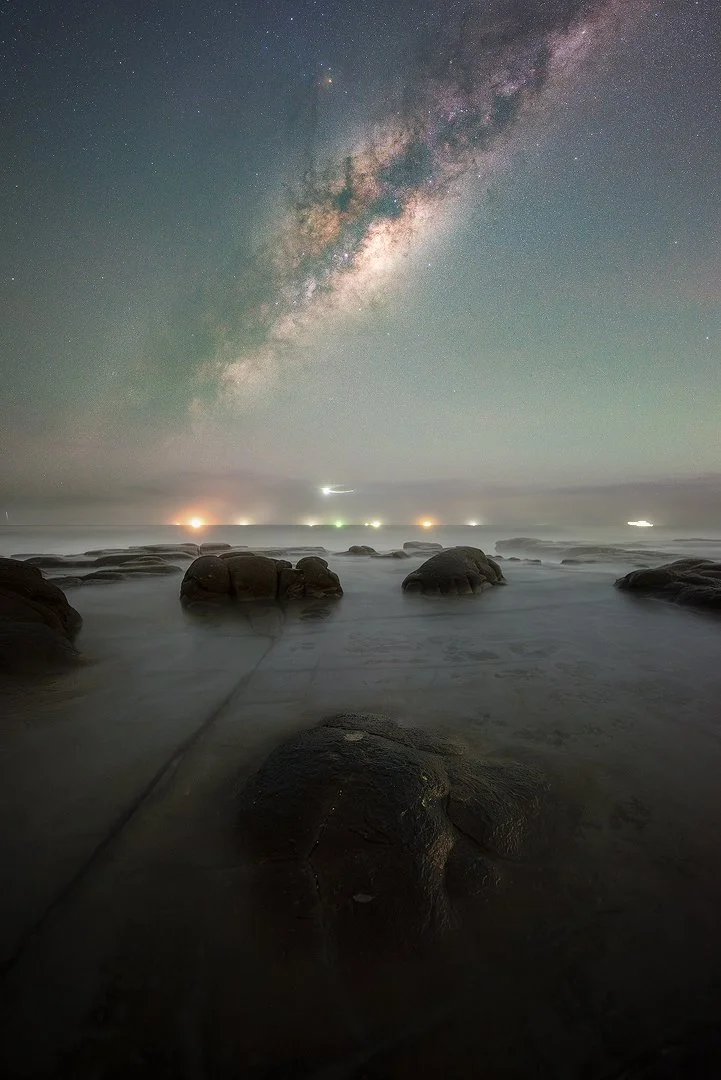
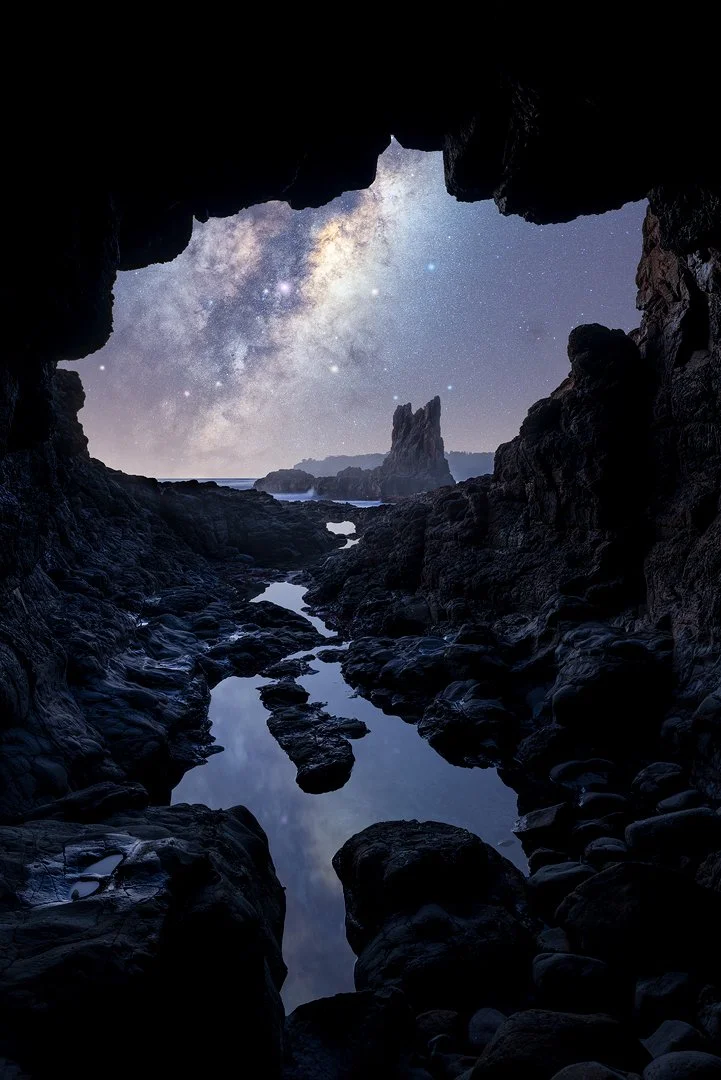
How to Photograph the Milky Way Australia

Astrophotography Guide · Australia

How to Photograph the Milky Way in Australia

A complete guide built for Australian conditions — southern hemisphere direction logic, season timing, camera settings by scenario, focusing in the dark, and practical location advice from South-East Queensland to the Red Centre.

Core season
February – October
Peak months
April – August
Starting settings
f/2.8 · 15–20s · ISO 3200
Direction logic
SE / E early, N mid, W later
Best moon window
New moon ± 4 days
300+
Photographers trained
9
Years teaching astro
Max 4
Workshop group size
6
Real EXIF examples
AU-specific
Season & direction guide

Most Milky Way guides are written for the northern hemisphere. They get the direction logic backwards, gloss over Australian humidity and transparency, and rarely explain how different our seasonal windows feel in practice. This guide is built for Australian conditions — real locations, real settings, and real field experience.

Australia is outrageously well suited to astro. We occupy only a small fraction of the continent, which leaves huge inland areas in genuine dark-sky country. Whether you're shooting with a kit lens from a paddock in the Wheatbelt or building a tracked composite in the Outback, the aim here is simple: sharper files, cleaner skies, and a workflow you can actually repeat.

01

Australian Direction Logic — What Northern Hemisphere Guides Get Wrong

In Australia, the Galactic Centre starts the season low between the east and south-east. As the season progresses, it rises earlier, climbs higher, and can stand much more upright as it tracks toward the northern part of the sky. Later in the season, after rotating through that higher northerly position, it tips over and drops toward the western horizon, where the lower, more horizontal look returns.

Think in phases: east early, north mid, west late. The exact angle shifts with latitude, so use this as planning logic, not a rigid rule.

Galactic Core Position by Month — Australia
Jan
Feb
Mar
Apr
May
Jun
Jul
Aug
Sep
Oct
Nov
Dec
Very limited
SE
low, rises late
SE → E
late evening
E
stronger rise
E → ENE
climbs higher
ENE → N
high, more upright
N → NW
vertical / flipping
NW → W
tips over west
W → WSW
lower, shorter
W / WSW
brief dusk window
Very limited
Off season
Peak season — strongest visibility and most flexibility
Visible season — workable, but shorter or more specific timing
Very limited / off season — low, brief, or not practically useful
Composition shortcut: low sweeping compositions usually happen earlier in the season facing SE to E, or later in the season facing NW to W / WSW. The ENE through N phase is often more upright and better treated as a deliberate stylistic choice, not the automatic best option.

Using PhotoPills for Australian direction planning

PhotoPills is the easiest way to confirm exactly where the core will sit for your location, date, and time. The key is not just knowing whether the core is up, but what angle it will be on — whether it is still rising low in the east, standing upright toward the north, or has already tipped over toward the west. That lets you decide whether the scene suits a low sweeping composition, a vertical core, or whether you should simply wait another hour or two for the orientation you actually want.

02

Season, Timing & Planning an Australian Milky Way Shoot

When is Milky Way season in Australia?

The Galactic Centre is visible from approximately February to October. In practice, the easiest and most rewarding stretch for most of Australia is April to August, when nights are longer, the core is easier to place in evening compositions, and inland winter air is often cleaner and drier.

February and March can absolutely work, but the core rises later and summer humidity is often higher, especially in Queensland and other coastal regions. By April the season becomes much more forgiving, and by winter you get a better mix of darkness, timing, and transparency.

Moon phase matters more than most people think

For a clean Milky Way core, aim for roughly new moon plus or minus four days. Beyond that, moonlight starts lifting the sky background enough to reduce contrast in the dust lanes and fainter outer structure. If the moon is up on the same side of the sky you're trying to shoot, it can ruin the shot faster than most people expect.

The main exception is when you're deliberately planning a blended foreground, a blue-hour composite, or a scene where a late-rising crescent gives you just enough foreground fill without washing out the sky earlier in the session.

Weather and transparency

Clear skies are the starting point, but transparency decides how crisp and contrasty the result feels. Thin high haze, coastal moisture, or dust in the air can kill detail even when the sky looks clear to your eyes.

My standard planning stack: PhotoPills for timing, Clear Outside for layered cloud, BOM for the broader weather picture, Windy for wind and upper atmosphere context, and Light Pollution Map for Bortle and local sky glow reality.

Coastal vs inland reality

For South-East Queensland especially, an inland drive is often the single biggest image-quality upgrade you can make. Coastal humidity softens detail, increases sky glow, and raises the chance of dew on your front element. Move inland and the difference is usually obvious in both contrast and keeper rate.
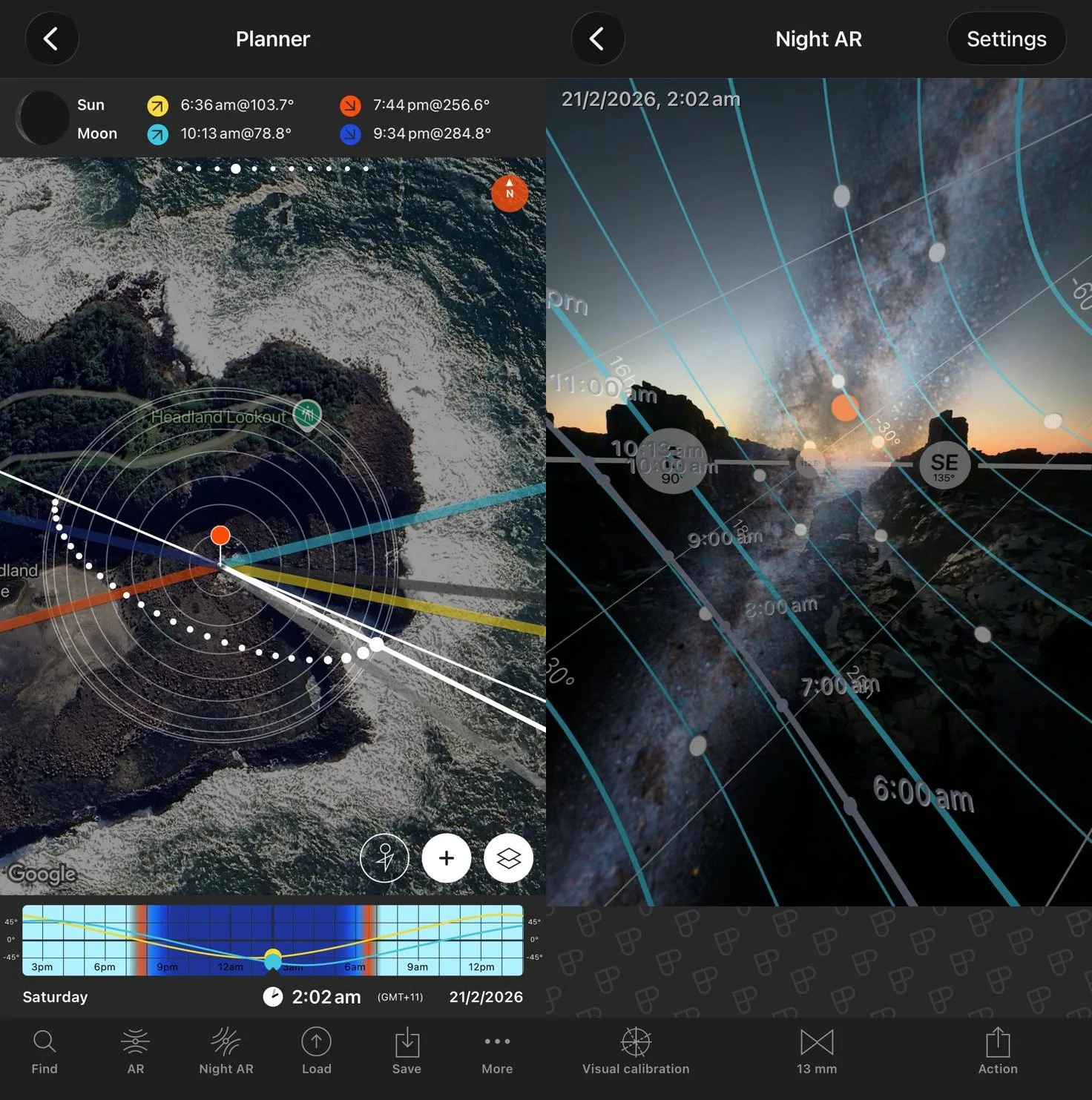
PhotoPills planning screenshot showing Milky Way alignment and timing
PhotoPills planning view in the field, showing the expected Milky Way alignment, timing, and angle before the shot was taken.
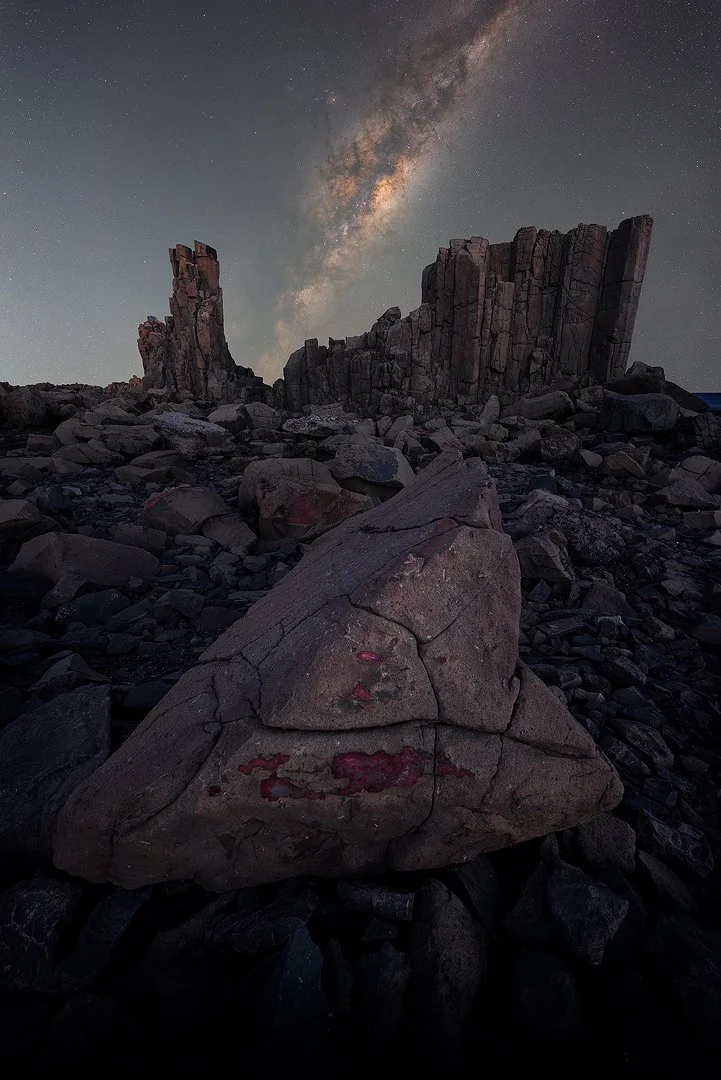
Finished Milky Way photograph from Bombo North End showing the planned alignment
Reference frame from Bombo North End showing how the planned alignment translated into the final image on location.
03

Camera Settings by Scenario — Start Here, Then Refine

Just use ISO 3200 and f/2.8 is not wrong, but it ignores tracker use, sensor size, coastal haze, and how your particular lens behaves wide open. Use the table below as your starting point, then check the histogram and the stars at 100% before settling in.

Scenario Aperture Shutter ISO Notes
Full-frame, dark sky (Bortle ≤4), no tracker f/2–f/2.8 15–20s ISO 3200 Reliable baseline. Check 100% for trailing. 20s is often safer than pushing longer on high-resolution bodies.
Full-frame, coastal / suburban (Bortle 5–6) f/2–f/2.8 10–15s ISO 2000–3200 Brighter sky means less tolerance. Do not chase exposure by blasting ISO if the sky itself is the problem.
APS-C, dark sky, no tracker f/2–f/2.8 10–15s ISO 3200–6400 Crop factor makes trailing show up sooner. Use a shorter shutter and accept the ISO trade.
Full-frame + tracker (tracked sky, separate foreground) f/2.8–f/4 60–180s ISO 800–1600 Run multiple tracked exposures, then stack. Separate foreground exposure keeps the workflow cleaner.
APS-C + tracker f/2.8 60–120s ISO 1600 This is where APS-C benefits massively. Even a modest tracked stack is a big jump from single-shot ISO 6400.
Wide-angle full-frame (14–20mm), dark sky f/2–f/2.8 15–20s ISO 3200 Use the NPF Rule in PhotoPills as your starting point, then confirm at 100% on the back of the camera. High-resolution bodies usually need a shorter shutter than older rules suggest.
Foreground blend / blue-hour foreground f/8–f/11 Varies ISO 100–400 Shoot the foreground separately and merge later. Cleaner than forcing everything into one compromise exposure.
Histogram check: your Milky Way frame should usually sit clear of the far-left wall, with enough exposure to show sky detail but without obvious clipping. A correctly exposed ISO 3200 file is usually cleaner than an underexposed ISO 1600 file pushed hard in post.

The NPF Rule — better than the old 500 Rule

The old 500 Rule is still a rough ballpark, but it is too loose for many modern high-resolution cameras. A more accurate approach is the NPF Rule, which takes into account focal length, aperture, and camera resolution to give a more realistic maximum shutter speed before stars start to trail. Open the Spot Stars calculator in PhotoPills and use the NPF result as your starting point, then take a test shot, zoom to 100%, and shorten the shutter further if your stars still look stretched.

04

How to Focus in the Dark — Exact Steps, No Guesswork

Blurry stars are the most common failure mode I see in workshop files. Not noise, not white balance, not the camera body. Focus. This is the exact method I teach in the field.

1
Switch to manual focus and live view

Turn autofocus off completely. You need full control and magnified live view on the rear screen.

2
Find the brightest star or planet you can

Jupiter, Venus, or a very bright star makes the process much easier than trying to focus on a dim point.

3
Magnify live view as far as your camera allows

Go to maximum zoom so the star becomes a blob you can actually refine.

4
Rotate slowly toward infinity

Most lenses do not hit true astro infinity exactly where the barrel markings suggest. Go slowly.

5
Overshoot slightly, then come back

When the blob gets larger again, you've passed the sharpest point. Back up until it is smallest and cleanest.

6
Take a test shot and check at 100%

Check a centre star and then a corner. Centre sharp and corners slightly worse is normal for fast wide-angle lenses. Centre soft means refocus.

7
Secure the ring if needed

A small piece of gaffer tape across the focus ring can save you from accidental movement during reframing.

Side-by-side comparison of a severely out of focus and correctly focused Milky Way crop at 50mm
Severely missed focus vs correctly focused at 50mm. At 14mm, missed focus is often subtler, but it still softens stars, weakens dust detail, and reduces the quality of the final file.

Focus failure modes — quick diagnosis

What you see Cause Fix
Stars with tails / streaks Shutter speed too long Reduce shutter speed and recheck at 100%.
Stars uniformly soft Missed focus Redo the live view focus method. Ignore the infinity mark.
Stars sharp, foreground blurry Normal when focused at infinity Shoot a separate foreground if you need depth front to back.
Corners messy, centre sharp Lens aberration / coma wide open Stop down slightly and raise ISO if needed.
Focus shifts after reframing Ring moved accidentally Retest focus before the next sequence.
05

Reducing Noise in Milky Way Photography

Noise is part of the job in low-light astrophotography. The aim is not to create a plastic-looking file. The aim is to get enough signal into the RAW file that your clean-up is gentle, not destructive.

Expose properly first
A well-exposed ISO 3200 frame usually cleans up better than a darker ISO 1600 frame pushed hard in post. Bad exposure creates ugly noise faster than high ISO does.
Beginner
Stack identical frames
Averaging multiple exposures is one of the most effective upgrades you can make without buying more gear. Great value for untracked shooting.
Beginner
Use a tracker
Longer exposures at lower ISO change the RAW file fundamentally, not just cosmetically. More signal, cleaner structure, more detail.
Advanced
AI denoise carefully
Useful, but easy to overdo. Protect fine star detail and do not let the sky turn into smeared velvet.
Beginner
Manage dew
Coastal and humid nights can ruin a session with front-element condensation before you notice it. A dew heater is cheap insurance.
Beginner
Drive further
Dark sky beats gear upgrades more often than people want to admit. Better sky usually gives a bigger gain than a new body.
Beginner
Coastal note: humidity reduces contrast before you even start editing, and it increases the chance of dew on the lens. On many Queensland nights, a short drive inland does more for image quality than any setting tweak.
06

Star Tracker vs No Tracker — Honest Assessment

A tracker is not required to take a good Milky Way image. But it does change what good can look like at full size. Here is the practical version, without the gear hype.

No tracker

  • Fast setup and simple workflow
  • Great for wide environmental compositions
  • Works with any camera and tripod
  • Ideal for learning focus, timing, and composition
  • Stacking a short series of frames can get you surprisingly far

With tracker

  • Much cleaner files at lower ISO
  • Longer exposures reveal more faint structure
  • Bigger payoff for larger prints and competition-level output
  • Adds setup time, alignment, and another failure point
  • Usually means a separate foreground workflow
Verdict: start without one. Get your focus, timing, composition, and exposure process reliable first. Once that is repeatable, a tracker becomes the fastest jump in file quality, especially if you want cleaner blends, stitched panos, or workshop-level tracked workflows without months of trial and error.
07

Best Milky Way Locations in Australia

Australia is one of the best countries on earth for Milky Way photography: huge dark-sky regions, genuine Bortle 1–2 areas, desert foregrounds, coastal rock platforms, alpine country, and enough latitude spread to give you a lot to work with. Because the inhabited footprint of the country is relatively small, huge parts of the interior stay properly dark.

South-East Queensland
Borumba Dam, Main Range, Darling Downs
Strong options within reach of Brisbane. Borumba is a practical dark-sky step up, while the ranges and inland country usually beat the coast for transparency and humidity.
Bortle
Borumba 2 · Main Range 2 · Darling Downs 1–4
Best months
May – August
Drive from Brisbane
90–180 min
Foregrounds
Reservoir, farmland, ranges
Outback QLD / SA
Channel Country, Flinders Ranges, Painted Desert
Some of the darkest sky in Australia. Exceptional if you want scale, silence, and clean winter atmosphere rather than coastal foregrounds.
Bortle
1–2
Best months
May – September
Access
Remote travel planning helps
Foregrounds
Plains, mesas, ranges
Northern Territory
Uluru, Karlu Karlu, Kings Canyon region
World-class dark sky and unmistakable desert foregrounds. Private visitors can photograph for personal use, but commercial or public-display photography requires the appropriate media permit, and culturally sensitive no-photography areas must be respected.
Bortle
1–2
Best months
April – September
Permit note
Check current park rules
Overnight temps
Can drop near 0°C in winter
South West WA
Cape Naturaliste, Fitzgerald River, Cape Le Grand, Stirling Range
Excellent if you want granite coastline, isolated bays, and cleaner inland sky just a relatively short distance from the coast. Cape Naturaliste can still work well, and the wider region only improves as you get further out.
Bortle
Cape Naturaliste 2 · wider region 1–3
Best months
May – August
Standout feature
Granite coastal foregrounds
NSW South Coast
Kiama, Bombo, Sapphire Coast, Jervis Bay
A strong mix of basalt, sea stacks, beaches, and cliff lines. You trade some darkness versus the Outback, but gain foreground variety and easy visual drama, especially once you move south of the more populated pockets.
Bortle
Kiama/Bombo 4–5 · Sapphire Coast 2 · Jervis 3–4
Best months
April – August
Foregrounds
Basalt, cliffs, sea stacks
Western NSW
Mungo National Park
World Heritage desert country with lunette walls, dunes, wide horizons, and a surreal minimal feel. Strong for clean, sparse foregrounds and big-sky compositions rather than busy coastline drama.
Bortle
1–2
Best months
April – September
Access
Check alerts and entry rules
Foregrounds
Lunettes, dunes, lookouts
Country NSW
Warrumbungle National Park
Australia’s first Dark Sky Park and one of the best public-access astro destinations in the country. Ideal if you want serious night skies without losing structured campgrounds and obvious lookout options.
Bortle
1–2
Best months
April – September
Standout feature
Dark Sky Park status
Foregrounds
Volcanic peaks, lookouts
South Australia
Kati Thanda-Lake Eyre National Park
Immense salt-lake country with surreal scale, desert silence, and properly dark sky. Better suited to well-prepared outback trips than casual overnighters, but visually it is in another league.
Bortle
1
Best months
May – September
Access
Remote 4WD planning helps
Park note
Seasonal heat closures can apply
South-East Queensland photographers: see the dedicated guide — Milky Way Photography Spots Within 2 Hours of Brisbane — for location-specific access notes, shooting angles, and practical planning.
08

Common Mistakes I See in Workshops

These are real mistakes from the field, not theory pulled from forums.

1
Trusting the infinity mark on the lens

Most lenses focus past true infinity for astro. The engraved mark is not your sharp point.

Fix: use live view every shoot, then secure the ring if needed.
2
Not checking the first frame at 100%

The rear screen can lie to you at normal review size. Soft stars often look fine until you zoom in properly.

Fix: check one centre star and one corner before committing to the set.
3
Shooting the wrong direction for the month

Beautiful foreground, wrong sky. It happens constantly when people skip planning.

Fix: screenshot the PhotoPills plan before leaving home.
4
Ignoring moonrise timing

Even a modest moon can lift the whole sky background faster than expected once it enters the scene.

Fix: plan around exact local moonrise and finish before it becomes a problem.
5
Underexposing out of fear of high ISO

Dark files pushed hard in post usually look worse than properly exposed high-ISO files.

Fix: expose for usable sky detail, not for fear.
6
Underestimating humidity and dew

Especially in Queensland, the air can look clear while still flattening contrast and fogging the front element.

Fix: go inland when you can and carry dew management.
09

Real Examples with Full EXIF

These are real Australian Milky Way images with exact capture settings for both foreground and tracked sky. They show the range of approaches — twilight blends, night blends, tracked composites, and panoramas.

Milky Way twilight blend above Mount Barney in Queensland
Mount Barney, Queensland — twilight blend with a tracked sky and clean natural foreground colour.
Location
Mount Barney, QLD
Foreground
f/11 · 1/20s · ISO 64
Sky
f/4 · 3 min · ISO 800
Focal length
14mm
Workflow
Twilight blend
Capture type
Tracked sky + separate FG
Lesson: This is a clean example of why twilight blends work so well. The foreground stays natural, detailed, and low-noise, while the tracked sky gives you the extra structure and depth in the Galactic Centre that a single compromise exposure would struggle to hold.
Milky Way twilight blend above the Big Rock at Bombo on the NSW South Coast
Bombo Big Rock, NSW — twilight foreground matched with a tracked sky for cleaner detail.
Location
Bombo, NSW
Foreground
f/11 · 30s · ISO 64
Sky
f/4 · 3 min · ISO 800
Focal length
14mm
Workflow
Twilight blend
Capture type
Tracked sky + separate FG
Lesson: A longer twilight foreground exposure lets the rock hold shape, texture, and colour without forcing ugly high-ISO noise into the land. This is one of the best workflows for dramatic coastal foregrounds where the land deserves as much attention as the sky.
Milky Way blend over Point Cartwright on the Sunshine Coast
Point Cartwright, Sunshine Coast — darker foreground approach with a tracked sky.
Location
Point Cartwright, QLD
Foreground
f/2.8 · 30s · ISO 3200
Sky
f/4 · 3 min · ISO 800
Focal length
14mm
Workflow
Night blend
Capture type
Tracked sky + separate FG
Lesson: You do not always need twilight to build a blend. Here the foreground was captured at night instead, which keeps the scene moodier and more consistent with the final sky.
Milky Way twilight blend above Cathedral Rock on the NSW South Coast
Cathedral Rock, NSW — a longer focal length twilight blend showing how tracked skies still work beautifully beyond 14mm.
Location
Cathedral Rock, NSW
Foreground
f/11 · 2s · ISO 64
Sky
f/4 · 3 min · ISO 800
Focal length
24mm
Workflow
Twilight blend
Capture type
Tracked sky + separate FG
Lesson: A tighter composition can still work extremely well. At 24mm, planning, tracking, and blending become even more important because every small exposure or focus mistake is easier to see.
Tracked Milky Way panorama from Cape York
Cape York, Queensland — tracked panorama using multiple frames stitched for a wider field of view and more immersive final composition.
Location
Cape York, QLD
Foreground
f/2.8 · 13s · ISO 6400
Sky
f/4 · 3 min · ISO 800
Focal length
14mm
Workflow
Tracked panorama blend
Capture type
Pano FG + tracked sky
Lesson: Panoramas let you go beyond the limitations of a single frame when the scene feels too big for one composition. They add stitching and alignment complexity, but the payoff is a much more expansive result when the location deserves it.
Milky Way blend above a remote waterfall in Cape York
Cape York, Queensland — a complex foreground where the waterfall and rock detail benefit heavily from a separate foreground capture.
Location
Cape York, QLD
Foreground
f/7.1 · 1/5s · ISO 2000
Sky
f/4 · 3 min · ISO 800
Focal length
14mm
Workflow
Twilight / low-light blend
Capture type
Tracked sky + separate FG
Lesson: Busy foregrounds like waterfalls are a strong argument for separate captures. A tracked sky stays clean while the foreground is exposed specifically for texture, water movement, and tonal control instead of forcing everything into one compromised file.
10

Frequently Asked Questions

What are the best months to photograph the Milky Way in Australia?
For most of Australia, April through August is the easiest and most rewarding stretch. February and March work, but the core rises later and humidity can be worse. October can still work, but the evening window is shorter and more fragile.
Do I need a star tracker to photograph the Milky Way?
No. A camera, tripod, and a reasonably fast wide-angle lens is enough to start. A tracker improves file quality and lowers ISO, but it also adds setup time and complexity. Learn the fundamentals first, then add tracking when you are ready to push file quality further.
Why are my stars blurry or trailing?
Blurry stars usually mean missed focus. Trailing means the shutter was too long for the focal length and output size. Fix focus first using live view, then trim shutter speed if the stars still streak.
What direction does the Milky Way appear in Australia?
Early in the season, the Galactic Centre usually starts low between the south-east and east. As the season progresses, it climbs higher and becomes more upright toward the north before later tipping over and becoming usable again toward the west. The exact angle shifts slightly depending on where you are in Australia, so always check your location and time in PhotoPills.
Why do clear Queensland coastal nights still look soft?
Because clear does not always mean transparent. Humidity, marine haze, and dew can flatten contrast even when there is no obvious cloud. Inland air is often the faster upgrade than changing gear or settings.
How dark does the sky need to be?
Bortle 4 and darker is where life gets easier. Bortle 5 can still work with good planning and strong foregrounds. Bortle 1–2 is where the dust lanes, faint colour, and overall experience really start to open up.
Can I use a kit lens for Milky Way photography?
Yes, but you are working with less light. A slower maximum aperture means higher ISO, shorter margins, and more careful exposure decisions. Still completely doable if you shoot RAW, expose properly, and keep expectations realistic.
What settings should I start with for Milky Way photography in Australia?
A solid full-frame dark-sky starting point is f/2.8, 15–20 seconds, ISO 3200. APS-C usually needs a shorter shutter and often a higher ISO. Use the NPF Rule in PhotoPills as your starting point, then refine from there based on your test shot and 100% star check.
Is there a Milky Way photography workshop near Brisbane?
Yes — Dylan Knight Photography runs small-group astrophotography workshops in South-East Queensland and beyond, with direct field coaching and conditions-led location choices. See the workshops overview for upcoming dates.

Take the Next Step in the Field

Download the free Australian Milky Way cheat sheet — a one-page quick reference for settings, focus steps, and a field workflow you can use in the dark.

Previous
Previous

Best Photography Locations on the Gold Coast

Next
Next

5 Best Milky Way Photography Spots Near Brisbane