5 Best Milky Way Photography Spots Near Brisbane
5 Best Milky Way Photography Spots
Within ~2 Hours of Brisbane
Bortle 2 dark skies, coastal foregrounds, and the mistakes I made so you do not waste a clear night. This guide covers the five Milky Way locations I keep coming back to in South-East Queensland, with GPS coordinates, best months, settings, and the small details that actually make or break the shoot.
One of the most common questions I get from South-East Queensland photographers is simple: where do you actually go to shoot the Milky Way without turning it into a full overnight mission? After years of scouting, testing, missing, and going back again, I keep coming back to the same five locations. Two give you genuinely dark Bortle 2 skies. Three are closer, brighter, and still very workable if you understand what they are good at.
This is not a generic list of pretty viewpoints. These are locations I have shot enough times to know what works, what does not, and what usually goes wrong the first time. You will get the GPS coordinates, best months, the type of Milky Way composition each spot suits, the settings I have used there, and the practical issues that quietly ruin shoots, like wind, dew, light spill, salt spray, mist, or the lighthouse beam suddenly blowing your highlights.
If you are looking for the best Milky Way photography locations near Brisbane, this is the straight version. No fluff. Just the five spots worth knowing and how to shoot them properly.
If you are in Brisbane, the Sunshine Coast, or the Gold Coast and want realistic Milky Way options within a reasonable drive, these are the locations I would shortlist first. If you only care about absolute darkness, start with Mount Barney and Borumba Dam. If you care about accessibility and recognisable foregrounds, Wildhorse, Noosa, and Point Cartwright are the smarter play.
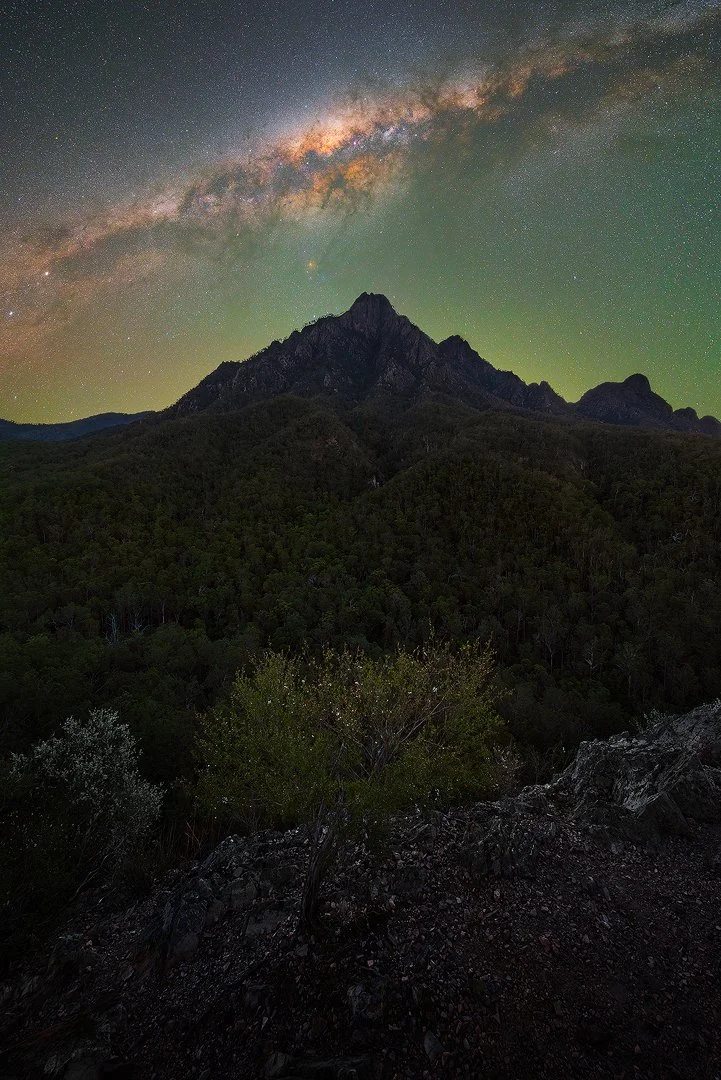
This is one of the best dark-sky locations within reach of Brisbane, full stop. On a clear night the Milky Way looks obvious to the naked eye, and the twin peaks give you a foreground that actually feels like a destination rather than just a patch of open sky. If you want the classic South-East Queensland mountain-meets-core composition, this is the one.
The galactic core rises in the east from around February, but the stronger compositions here are later in season when you can frame the core setting or leaning over the western side of the mountain. The exact alignment shifts a lot through the season, so this is one of those locations where PhotoPills matters.
There are a few ways to shoot it, but Yellow Pinch is the best-known option for a reason. The view opens up properly once you move beyond the easiest access points. Shooting down low near the lodge or car park can work, but you need to manage stray light carefully.
I shot too low from the main access area on my first visits and underestimated how much the lodge lights would contaminate the foreground. The darkness is excellent, but local light spill can still ruin the feel of the shot if your angle is lazy.
Tracked composite. Twilight foreground at f/11, 1/20 sec, ISO 64, 14mm. Sky tracked at f/4, 3 min, ISO 800, 14mm. Manual focus on a bright star and lock it in before the real shoot starts.
Mount Barney is the place to slow down and do it properly. Dark sky hides a lot of mistakes, but it also rewards better composition more than any other spot on this list.

Borumba is the backup plan that is good enough to stop feeling like a backup. Same genuine darkness as Mount Barney, but a completely different kind of image. You are working with water, reflections, open horizon, and a more forgiving setup area. When the surface goes still, it can produce one of the cleanest Milky Way reflection frames you will get anywhere near South-East Queensland.
The catch is that the reflection only exists when the dam is calm. A little bit of wind and the magic is gone. That is why Borumba is a location I decide on late. It is one of the few astro spots where wind speed matters almost as much as cloud cover.
If you see mist forming over the water, move higher immediately. It looks atmospheric for about five minutes, then turns into a wall between you and the stars. Dew is also common here, so a lens warmer is worth bringing every time.
Check Windy before you commit. If the wind is above about 10 km/h after sunset, stop chasing reflections and change the plan. Shoot from higher ground or accept that it is a sky-only night.
Sky tracked at f/4, 3 min, ISO 800, 14mm. Foreground at f/2.8, 3 min, ISO 3200, 14mm. For calm-water reflection attempts, I work in the 8–13 sec range when the conditions allow it.
Borumba is the best spot on this list for photographers who want clean Milky Way work without a steep access or technical foreground problem.
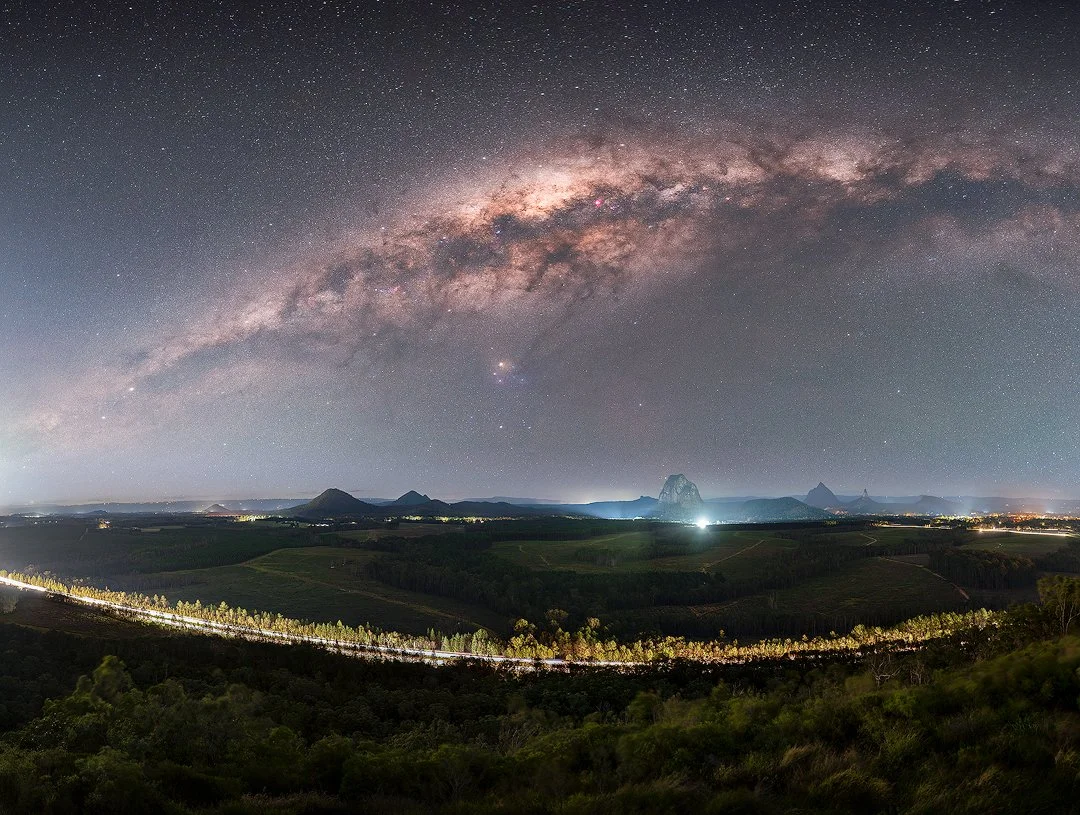
Wildhorse is the practical choice. It is not the darkest. It is not the cleanest. But it is the easiest decent Milky Way location to actually use when you have work the next day and still want to get out under the stars. That matters more than people admit.
The elevated lookout helps cut through some of the surrounding light pollution, and the Glass House Mountains give you a recognisable horizon. Early season the core is more eastern. Mid to late season is when it gets more interesting, as the Milky Way shifts into better western compositions over the range.
This location rewards better technique because the sky is not doing all the work for you. If you are sloppy with exposure, horizon glow, or tripod stability, the files fall apart fast. If you shoot carefully, it can still deliver strong results.
If you do not have a tracker or a stacking workflow, a light pollution filter can make a surprisingly useful difference here. This is one of the few locations where small technical gains really show up in the final file.
Foreground at ISO 800, f/1.4, 30 sec, 50mm. Sky tracked at f/4, 3 min, ISO 800, 14mm. In post, I usually pull highlights down hard and add a controlled amount of Dehaze to recover contrast in the core.
Hook your camera bag under the tripod. Even a modest breeze on that platform can soften frames and waste a clear night.

This one earns its place because it solves a specific problem. If you want the Milky Way rising over the ocean, this is one of the cleanest accessible options in South-East Queensland. Inland spots cannot give you that eastern water horizon, and that alone makes Noosa worth the drive.
Timing is everything here. The core is there, but the air quality decides whether the file looks crisp or washed out. Offshore winds are your friend. Onshore winds and heavy salt in the air will quietly soften your stars until you get home and realise the whole session has a haze on it.
This is also one of those spots that becomes easier once you scout it in daylight. The track, headland positions, and safe setup options make a lot more sense after a quick sunset or sunrise reconnaissance.
Check the coastal forecast, not just the general forecast. Above about 15 km/h onshore, your front element can coat up fast. A clear high-pressure night with a light offshore breeze is the play.
Foreground at ISO 64, f/11, 30 sec, 14mm. Sky tracked at f/4, 3 min, ISO 800, 14mm. Keep a microfibre cloth in your pocket and actually use it.
If your goal is a coastal Milky Way shot that does not look like every inland dark-sky frame, Noosa is one of the smartest options on this whole list.

Point Cartwright is not on this list because it is dark. It is on this list because the lighthouse gives you one of the most recognisable astro foregrounds in South-East Queensland, and sometimes composition beats darkness. If you want a location that feels iconic straight away, this is it.
The lighthouse beam is the challenge and the opportunity. It can blow your highlights when it clips the frame, but it can also act as a natural light source that gives the foreground life. When you get the timing right, it does something light painting usually cannot.
The headland is exposed almost every time, so tripod discipline matters. No centre column. Thickest leg sections first. Stay low. Wipe your front element regularly because salt spray is constant here, especially if there is any swell and breeze working together.
Check your histogram after every frame. The lighthouse beam can turn a perfectly exposed setup into a spiked mess if it hits during the wrong moment in the exposure.
Foreground at ISO 3200, f/2.8, 13 sec, 14mm. Sky tracked at f/4, 3 min, ISO 800, 14mm. Stability matters more here than chasing one extra stop of light.
This is one of the best “I have a short weather window, let’s go now” astro locations on the Sunshine Coast.
The 3 Things That Matter Most
Moon phase
- Plan around new moon, ideally within ±3 days
- Even a modest moon can flatten contrast badly at Bortle 4 sites
- If the moon is up during your main core window, rethink the night
Cloud cover
- Check Windy again about 6 hours before leaving
- Layer maps matter more than a generic rain forecast
- If you are seeing meaningful cloud after 9 pm, do not force it
Galactic core position
- The core is not visible year-round from South-East Queensland
- Best season runs roughly February through October
- Use PhotoPills for exact rise angle and direction on your date
| Location | Best for | Darkness | Best months | Main issue |
|---|---|---|---|---|
| Mount Barney | Classic dark-sky mountain composition | Bortle 2 | Apr–Sep | Light spill if you shoot too low |
| Borumba Dam | Reflections and easy dark-sky access | Bortle 2 | May–Oct | Wind, dew, mist over water |
| Wildhorse Mountain | Closest practical Brisbane option | Bortle 4 | Feb–Oct | Wind and ambient glow |
| Noosa, Alexandria Bay | Milky Way rising over the ocean | Bortle 4 | Feb–Jun | Salt spray and humidity |
| Point Cartwright | Lighthouse foreground astro | Bortle 4 | Mar–Jul | Wind and lighthouse beam timing |
If you only get one or two clear astro windows a month, stop picking locations on vibe alone. Pick the place that best suits the conditions that night. Calm and clear? Borumba. Dry and dark? Mount Barney. Short notice after work? Wildhorse. Offshore coastal night? Noosa. Windy but compositional? Point Cartwright.
FAQ
Learn These Spots Properly,
On Location
I run small-group workshops across these South-East Queensland locations throughout the year, including Noosa, Point Cartwright, Mount Barney, and the Gold Coast hinterland. Conditions-led planning, hands-on field tuition, and editing sessions built around real locations, not theory.
Small groups, real planning, no guesswork