Weather Decides to Test You — Sapphire Coast Workshop Recap
When the weather decides to test you
Four days. Four photographers. Three nights on the Sapphire Coast. The forecast was bleak from the start — flat skies, thick cloud, no golden hour in sight. But that's not the story. What happened next is why I'll run this workshop every year.
The Sapphire Coast workshop runs once a year, deliberately. It's built around autumn light on the NSW south coast — a window when the angle of the sun is lower, the water is still warm enough for rock platform access, and the crowds that fill Narooma and Bermagui in summer have mostly gone. What it can't be built around is the weather. Nobody gets to choose that.
This year, the weather chose for us. Three days of thick overcast, no directional light, no dawn colour, no evening glow. The kind of forecast that would make a lot of photographers question whether they'd booked the right trip. But here's the thing — a workshop that only works in good conditions isn't actually a workshop. It's a guided shoot with favourable odds. What we ran across four days was something more useful than that.
This recap covers the four main lessons from the week — what we shot, what we learned, and what the final morning at Horsehead Rock reminded us all about why we do this.
Flat light forces better composition
The first two days arrived with exactly what the forecast promised: a thick, featureless overcast that flattened everything. No shadows. No directional light. No drama handed to us on a plate.
This is the moment most photographers pack away the camera and wait for better conditions. We didn't. Instead we used it as a lesson in what actually carries an image when light refuses to do the heavy lifting: composition.
When you can't rely on golden hour to bail you out, every decision becomes intentional. Where you stand. What you exclude from the frame. How you layer foreground, mid-ground, and background. Without the distraction of beautiful light, you're forced to think about structure — and that's a skill that transfers across every condition you'll ever shoot in.
"Flat light doesn't ruin the shot. It reveals whether the composition was strong enough to begin with."
We worked the coastline deliberately, looking for leading lines in the rock formations, using the receding tide to create depth, and spending time on compositions before ever lifting the camera to our eye. The resulting images weren't the ones anyone expected to take. They were better in a different way.
Shoot in bad light on purpose — at least once. You'll return to good light as a fundamentally stronger photographer. The conditions don't determine the image. Your decisions do.
Monochrome and B&W: two different tools
Overcast coastal light has one gift that photographers consistently miss: it's extraordinarily well-suited to black and white and monochrome processing. The absence of competing colour means you're working purely with tone, texture, and shape — and the soft, even illumination from cloud cover renders detail beautifully.
In the editing session we looked at both approaches side by side. They're not the same thing, and it's worth understanding the difference.
Monochrome is about retaining luminosity and tonal range — a precise, clean conversion that maps colour information into tone. It tends to feel more measured and graphic. Black and white, processed with contrast and midtone manipulation, pushes toward mood. Crushed blacks. Lifted highlights. The drama that the weather refused to give us in the field.
I edited two shots from the weekend to demonstrate this. Both valid. Both made from images that most photographers would have never taken in those conditions.
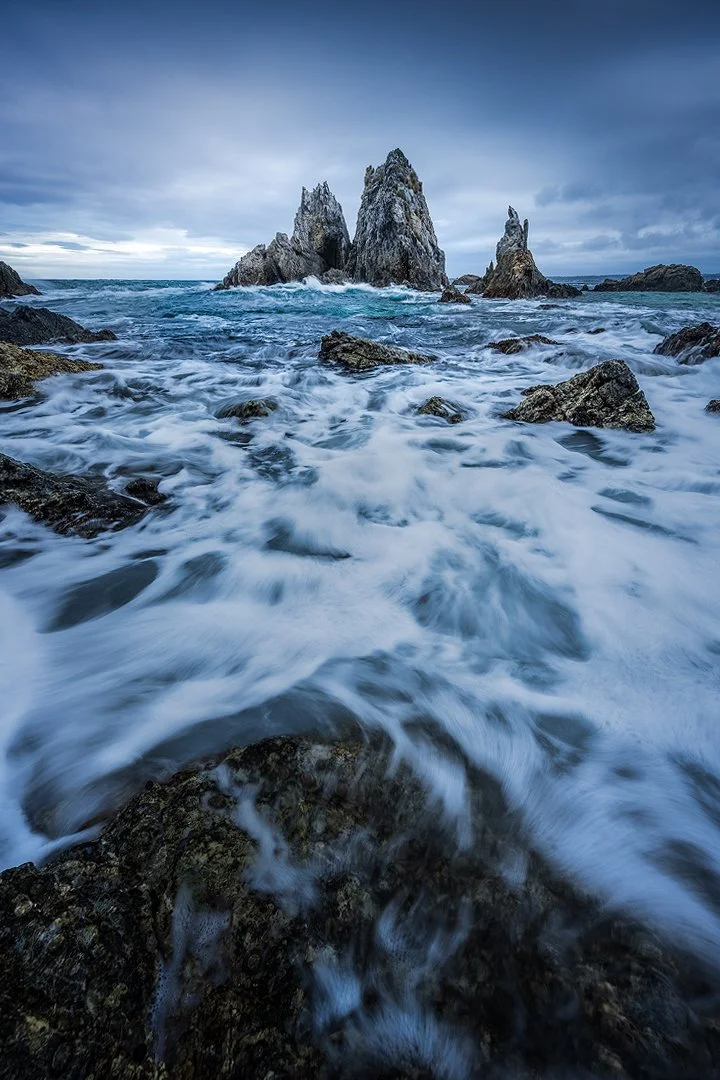
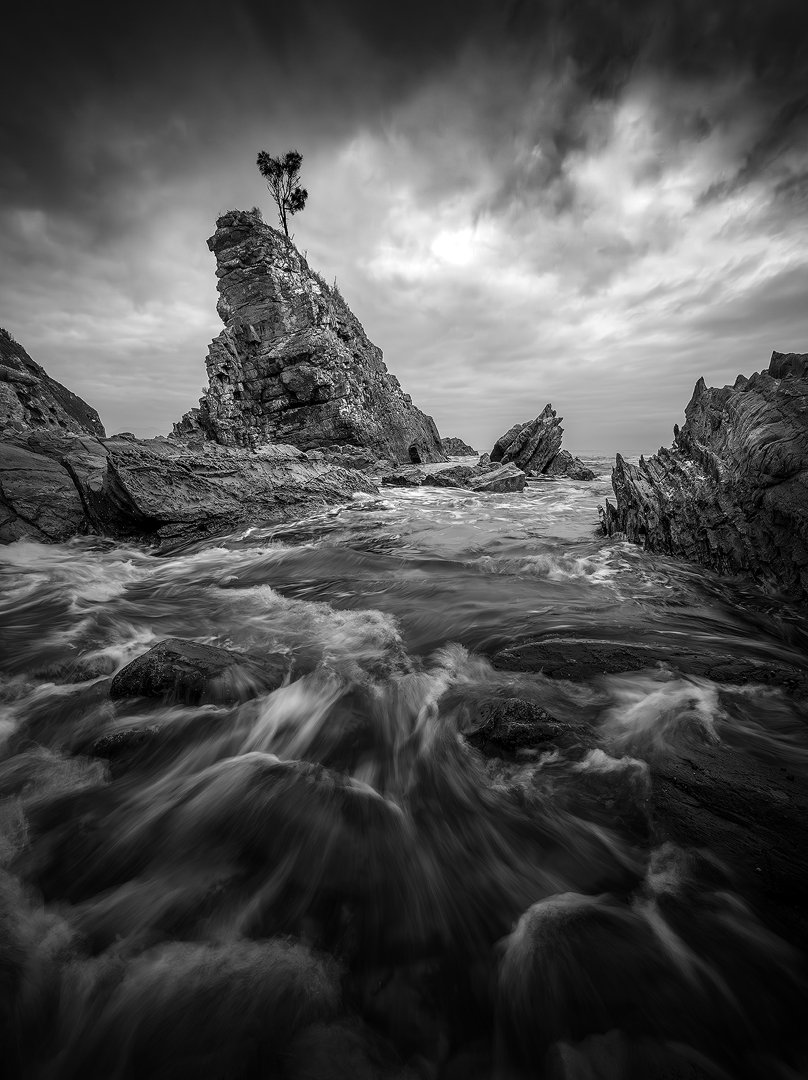
How to choose between them
The decision isn't aesthetic preference — it's dictated by the image. If the scene has clean structural geometry, strong tonal separation, and reads clearly without heavy contrast manipulation, monochrome conversion is usually cleaner and more credible. If the scene needs drama to work — if the light was flat and you need the processing to carry emotional weight — a full black and white treatment with lifted highlights and crushed shadows can rescue a frame that colour processing can't.
Pull the same RAW file into both treatments before committing. Give it 60 seconds. You'll usually know immediately which one is doing more work for the image.
Next time you shoot in flat or overcast conditions, don't fight the light — work with it. Pull the RAW into Lightroom and try both approaches before you decide the session was a write-off.
Ethical Milky Way blending: how it actually works
Ethical Milky Way blending is one of those topics that gets misunderstood — and the misunderstanding usually comes from confusing two very different situations where blending is the right call.
Situation one: you can't go back
Sometimes you visit a location once and you capture the foreground perfectly — but the Milky Way isn't in position, the sky isn't dark enough, or the conditions simply don't cooperate. If you've used PhotoPills to model the exact alignment beforehand, you know that the composition is achievable. Blending a sky captured later at that same location, with matching lens and focal length, isn't fabricating a scene. It's documenting a scene that's physically real — just not on one night.
Situation two: star trackers
This is the one most astrophotographers don't talk about openly. When I shoot with a star tracker, the device counteracts the rotation of the earth to keep stars sharp. The consequence is that the foreground becomes blurred during the exposure. A sharp sky and a sharp foreground from a single tracked exposure is physically impossible. Blending isn't a creative shortcut here — it's technically required to produce an accurate result.
On this workshop the conditions didn't allow for a full night session, so on the last morning I ran a focused walkthrough using Milky Way data I'd captured previously in matching Bortle skies. We worked through the full process: planning the alignment in PhotoPills, masking in Photoshop, matching tones and colour temperature, and the complete Milky Way editing workflow from raw processing through to the final composite.
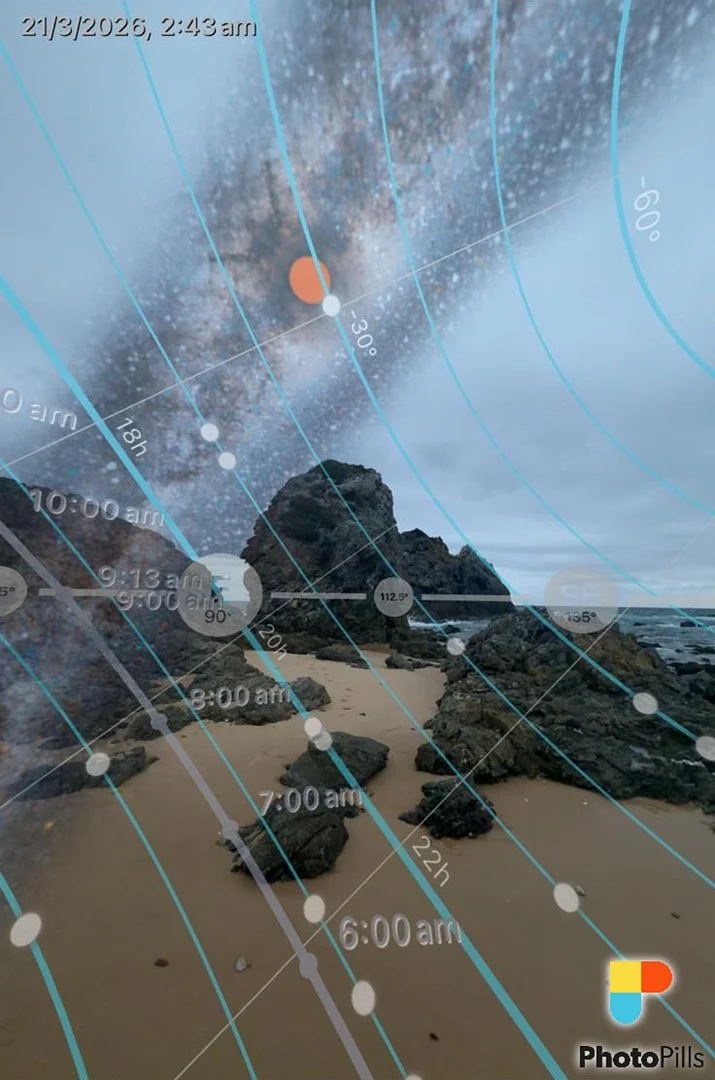

"The ethics aren't about whether you blended. They're about whether the result represents something physically possible — and whether you're honest about your process."
Plan before you shoot. If you're serious about astrophotography, PhotoPills isn't optional — it's how you know whether the shot you want is achievable at all. The blend is the last 10%. The other 90% is showing up prepared.
The last morning: why light changes everything
The final morning of the Sapphire Coast workshop is one I won't forget quickly. After three days of flat overcast sky, the cloud broke at Horsehead Rock during the pre-dawn session — and what arrived wasn't just good light. It was the kind of light that makes every early alarm, every cold drive, every session you pushed through in ordinary conditions feel completely worth it.
Colour swept across the sky, deep pinks and warm ambers stacking above the horizon as side light raked across the rock formations. And that's the thing about side light that you genuinely cannot replicate in post-processing: the three-dimensional quality it creates. Shadows fall at angles that carve depth into surfaces. Textures that are invisible under flat light suddenly become the entire subject. The scene stops being flat and starts feeling like you can reach into the frame.
We'd spent three days building the toolkit — composition, tonal conversion, technical night work. The last morning was where all of it arrived together. The participants who had been frustrated by the weather on day one were now standing in front of conditions that rewarded every decision they'd made across the weekend.

The other side of Horsehead
What most photographers don't realise is that Horsehead Rock has two completely different shooting environments within minutes of each other. The arch is the iconic image — and it earns that status. But the beach on the other side of the headland is rarely photographed, and on the right morning it produces something entirely different: a wide pebble platform, clean leading lines through the wash, and the golden backlight flooding through gaps in the rock stack as the sun lifts behind it.
This is where conditions and preparation converge. We'd scouted the position the previous morning in flat light. On the final morning, with the sky finally doing something worth pointing a camera at, we already knew exactly where to stand.

"Three days of flat light teaches you to make strong images. One morning of the right conditions teaches you why you do this at all."
This is the reason I talk about light as a differentiator — not as a cliche, but as a practical truth. The image from that final morning isn't technically superior to the others. But the light makes it feel like a different world. That's not something you can manufacture. You have to be there, prepared, when it decides to show up.
Keep showing up in ordinary conditions. The photographers who get the extraordinary shots aren't luckier — they've just built the habit of being there so that when the light finally arrives, they're ready for it.
The 2027 Sapphire Coast Workshop
The Sapphire Coast workshop will run again in April 2027. Same format — four days, small group, conditions-led approach across Narooma and Bermagui. New moon timing selected for the best possible astro window. Horsehead Rock at first light, whatever the weather brings.
Dates, pricing, and the full itinerary are on the workshop page. Priority registration is open now.
Join me on the Sapphire Coast in 2027
Small group. Serious instruction. And if we're lucky, one of those last-morning moments that makes everything else worth it.